7 Powerful Brain-Computer Interface Research Findings
Brain-Computer Interface Research Findings are revealing how rapidly scientists are developing systems that can connect brain activity with computers, robotic devices, speech systems, and other technologies. Recent research has moved beyond simple laboratory demonstrations toward communication, movement restoration, AI-assisted control, and more stable neural decoding. However, the technology is still largely experimental, and important challenges remain around reliability, safety, long-term use, ethics, and accessibility.
Table of Contents
- What Are Brain-Computer Interfaces?
- Brain-Computer Interface Research Findings on Communication
- Brain-Computer Interface Research Findings on Movement
- Brain-Computer Interface Research Findings on AI
- Brain-Computer Interface Research Findings on Wearable Technology
- Brain-Computer Interface Research Findings on Neural Stability
- Brain-Computer Interface Research Findings on Clinical Research
- Brain-Computer Interface Research Findings and Future Challenges
- Conclusion
What Are Brain-Computer Interfaces?
A brain-computer interface, commonly called a BCI, is a technology designed to create a direct communication pathway between brain activity and an external computer or device. Instead of relying entirely on muscles, keyboards, or conventional controllers, a BCI can record neural signals and use software to interpret those signals as commands.
Researchers are exploring both implanted and non-invasive BCIs. Implanted systems use electrodes placed inside or on the surface of the brain, while non-invasive systems can measure brain activity from outside the skull. Each approach involves different trade-offs involving signal quality, safety, convenience, and long-term usability.
Recent Brain-Computer Interface Research Findings show that the field is becoming increasingly connected with artificial intelligence, machine learning, robotics, speech synthesis, and personalized medicine.
Brain-Computer Interface Research Findings on Communication
One of the most important areas of BCI research is restoring communication for people who have lost the ability to speak because of paralysis or neurological injury.
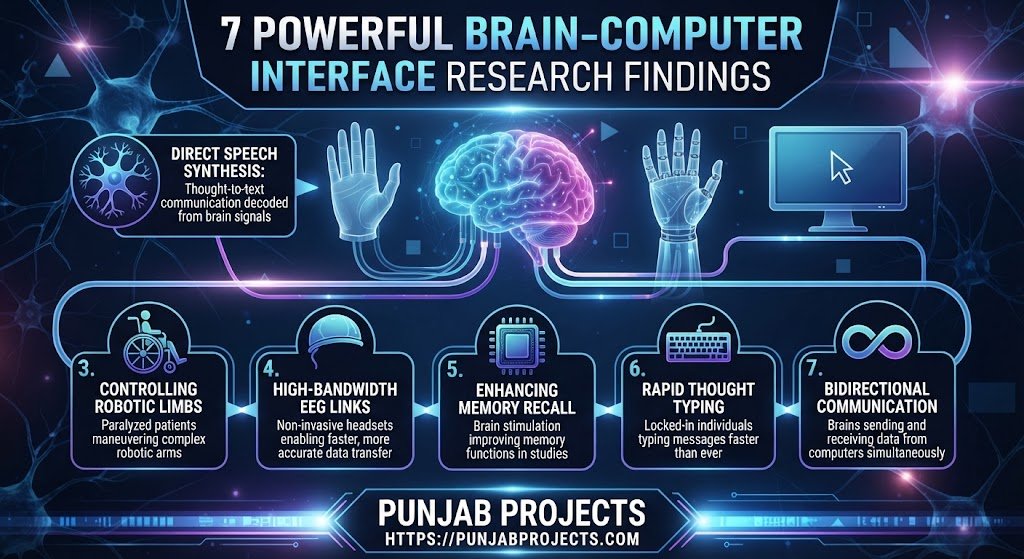
A major 2025 development reported by the National Institutes of Health involved a brain-computer interface that translated attempted speech-related brain activity into audible words. The system was tested in a woman with paralysis who had been unable to speak following a stroke. Researchers trained a deep-learning system using thousands of attempted sentences and converted neural activity into synthesized speech.
Another 2025 research development explored decoding inner speech, meaning words a person is thinking without physically speaking. NIH reported that researchers designed a system capable of decoding inner speech in real time from activity in the brain’s motor cortex. This could eventually provide another communication pathway for people with severe paralysis, although the technology remains experimental.
Brain-Computer Interface Research Findings on Natural Speech
The research direction is particularly important because communication speed and naturalness matter. A system that produces only slow or fragmented words may be less useful for ordinary conversation than one capable of producing more continuous speech.
Research reported in 2025 also described a voice-synthesis neuroprosthesis for a man with ALS, demonstrating the continuing effort to produce natural-sounding speech from neural activity.
These Brain-Computer Interface Research Findings suggest that future communication BCIs may focus not only on recognizing individual words but also on producing faster, more natural conversations.
Brain-Computer Interface Research Findings on Movement
Movement restoration is another major area of BCI research. Scientists have been studying whether brain signals can control computer cursors, robotic arms, virtual environments, and other assistive technologies.
Implanted BCIs have been investigated for decades, and a 2025 review of clinical trials identified 28 trials involving 67 participants across 21 research groups for implanted BCIs targeting communication, motor control, or tactile perception. The review also highlighted major challenges involving participant diversity, data sharing, standards, regulation, and long-term performance.
The basic idea is relatively straightforward. A person attempts a movement, sensors record relevant neural activity, and computational models decode those signals into commands. The external device can then respond to the decoded command.
The difficult part is making this process reliable. Neural signals can change over time, and the relationship between brain activity and intended movement is not perfectly fixed.
Brain-Computer Interface Research Findings on AI
Artificial intelligence is becoming an increasingly important component of modern BCI research. Machine-learning models can analyze large amounts of neural data and identify patterns that are difficult to interpret manually.
A 2025 study published in Nature Machine Intelligence examined BCI control with AI copilots. Researchers combined a non-invasive BCI with AI assistance and reported improved task performance, including a reported 3.9-times-higher target hit rate for a cursor-control task involving a participant with paralysis. The study also demonstrated robotic-arm control with AI assistance for a task that the participant could not perform without the copilot.
Brain-Computer Interface Research Findings on Shared Control
This approach is different from asking a BCI to perform every part of a task independently. Instead, the human provides neural commands while AI helps interpret or complete the intended action.
For example, a user might provide a general movement intention while an AI system helps determine the precise trajectory needed to reach a target.
This shared-control approach could reduce the amount of precise neural information required from the user. However, researchers still need to determine how these systems should handle errors, uncertainty, user preferences, and safety.
Brain-Computer Interface Research Findings on Wearable Technology
Not all BCIs require implanted electrodes. Researchers are also developing flexible and wearable neural sensors that can collect brain signals without surgical implantation.
A 2025 review of flexible brain electronic sensors described their potential for wearable BCI applications, including health monitoring and disease-related applications. The research emphasizes the challenge of achieving useful spatial and temporal resolution while maintaining practical wearable designs.
Non-invasive BCIs may eventually be easier to deploy because they do not require brain surgery. However, obtaining clean and precise neural signals from outside the skull can be difficult.
This creates an important research trade-off: implanted systems can potentially access stronger and more detailed signals, while non-invasive systems can offer a different safety and usability profile.
Brain-Computer Interface Research Findings on Neural Stability
One of the biggest technical challenges identified in current research is maintaining stable BCI performance over time.
A 2025 Nature Communications study explained that intracortical BCIs can experience instability at the neural interface. Such instability may reduce decoding performance and create the need for repeated recalibration using new labeled data.
This matters because a practical BCI cannot depend on constant technical adjustments. Researchers want systems that can continue interpreting neural signals accurately as conditions change.
Future systems may therefore combine better electrode designs, adaptive algorithms, machine learning, and improved signal-processing techniques to maintain performance.
Key BCI research areas
Illustrative research-focus comparison for explaining the major areas discussed in this article; values are not clinical measurements.0255075100
Communication
Movement
AI-assisted control
Wearable BCIs
Neural stability
Clinical translation
Illustrative values only, not measured research statistics.
Brain-Computer Interface Research Findings on Clinical Research
Although BCI research has produced impressive experimental results, it is important to distinguish research demonstrations from widely available medical products.
The 2025 review of implanted BCI clinical trials found that implanted systems have been investigated since the late 1990s, but the field still faces major challenges before broad clinical adoption. The review noted that no implanted BCI had received regulatory approval for the medical-device market at the time of publication.
Researchers are therefore studying more than just whether a device works once. They also need to understand how long it can remain functional, how consistently it performs, how users interact with it, and how risks should be managed.
Brain-Computer Interface Research Findings on Long-Term Use
Long-term performance is particularly important for people who may depend on these systems for communication or movement assistance.
The clinical-trial review reported increasing longevity of chronic implanted BCIs, with a mean participation longevity of 40.2 months among patients who were active in the reviewed trials. At the same time, the authors noted variation in consistency and performance between individuals.
This demonstrates why BCI research needs to examine years of use rather than focusing only on short laboratory experiments.
Brain-Computer Interface Research Findings and Future Challenges
The future of BCIs will depend on solving several scientific and practical problems. Signal stability is one challenge, while surgery and device longevity are important considerations for implanted systems. Non-invasive systems face their own challenges in obtaining high-quality neural information.
Ethics is another major research area. When a device records neural activity, questions arise about who controls the data, how it should be stored, and how researchers should protect participants. The clinical-trial review specifically highlighted issues involving data ownership, participant diversity, data sharing, and standards.
There is also growing interest in systems that can both read and influence neural activity. Recent research and commentary have explored bidirectional BCIs and AI-assisted neurotechnology, but these approaches remain areas of active research rather than established everyday consumer technology.
Conclusion
The latest Brain-Computer Interface Research Findings show a field moving toward more capable communication systems, robotic control, AI-assisted interaction, wearable sensors, and increasingly sophisticated neural decoding. Research published in 2025 demonstrated important progress in speech restoration, inner-speech decoding, AI-supported BCI control, and neural signal processing.
At the same time, BCIs remain an emerging technology. Long-term reliability, safety, signal stability, clinical validation, regulation, ethics, and accessibility all need further research. The most important development may therefore not be a single futuristic device, but the gradual combination of neuroscience, artificial intelligence, engineering, and medicine into systems that can work reliably for real people.