AI Research Blind Spots: 7 Critical Risks Scientists Should Know
AI Research Blind Spots are becoming an important concern as artificial intelligence becomes more involved in scientific research. AI can analyze huge collections of papers, datasets, images, and experimental results much faster than humans, but speed does not mean perfection. Some important information can be overlooked, misunderstood, or incorrectly connected. These hidden limitations are known as research blind spots, and understanding them can help scientists use AI more safely and effectively.
Table of Contents
- What Are AI Research Blind Spots?
- Why AI Research Blind Spots Matter
- 7 Critical Risks Scientists Should Know
- How Scientists Can Reduce AI Blind Spots
- AI Research Blind Spots: Benefits and Challenges
- Frequently Asked Questions
- Conclusion
What Are AI Research Blind Spots?
AI Research Blind Spots are areas of scientific information, evidence, context, or uncertainty that an artificial intelligence system may fail to recognize correctly.
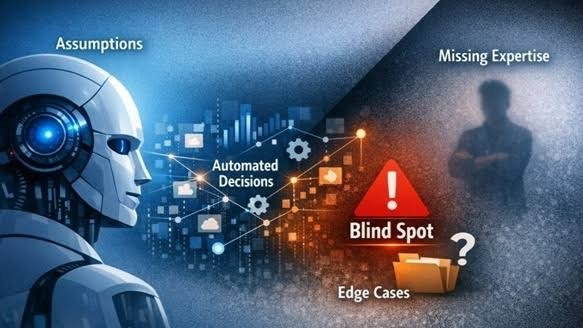
AI can process enormous amounts of information, but it does not automatically understand every scientific detail. A research paper may contain an important limitation that an AI system overlooks. A dataset may leave out a particular population or condition. Two studies may use similar words while actually investigating different questions.
These situations can create blind spots.
A blind spot does not necessarily mean that AI is useless. Instead, it shows why AI-generated findings should be treated as useful research assistance rather than unquestionable scientific conclusions.
Why AI Research Blind Spots Matter
Scientific research depends on accurate evidence. If an AI system misses an important limitation, researchers could potentially reach an incomplete conclusion.

The problem becomes more important when AI is used for literature reviews, data analysis, hypothesis generation, experiment planning, or scientific discovery.
Researchers therefore need to understand both the strengths and weaknesses of AI.
AI Research Blind Spots can occur because of incomplete datasets, limited training information, ambiguous language, hidden assumptions, statistical problems, or insufficient understanding of scientific context.
The good news is that many of these risks can be reduced through human review, better datasets, transparent methods, and independent verification.
7 Critical AI Research Blind Spots Scientists Should Know
1. AI Research Blind Spots Can Come From Missing Data
One of the biggest problems is incomplete data.
An AI system can only analyze the information available to it. If important studies, observations, languages, populations, or experimental results are missing, the system may create an incomplete picture of a research field.
For example, imagine a scientific database containing thousands of studies but excluding research published in several languages. An AI system analyzing that database might incorrectly conclude that certain questions have received little attention.
The apparent research gap could therefore be a data-access problem rather than a genuine scientific gap.
Scientists should check the coverage of the sources before accepting an AI-generated conclusion.
2. AI Research Blind Spots Can Misunderstand Context
Scientific language is often highly specialized.
The same word can have different meanings in different disciplines. A term used in medicine may have a different meaning in engineering or biology.
AI can identify similarities between words and concepts, but similarity does not always mean scientific equivalence.
A research paper may also contain important context in a figure, footnote, methodology section, or limitation statement. If the AI analysis focuses heavily on the abstract or main text, it may miss information that changes the interpretation.
For this reason, researchers should return to the original source before making important decisions.
3. AI Research Blind Spots Can Miss Research Bias
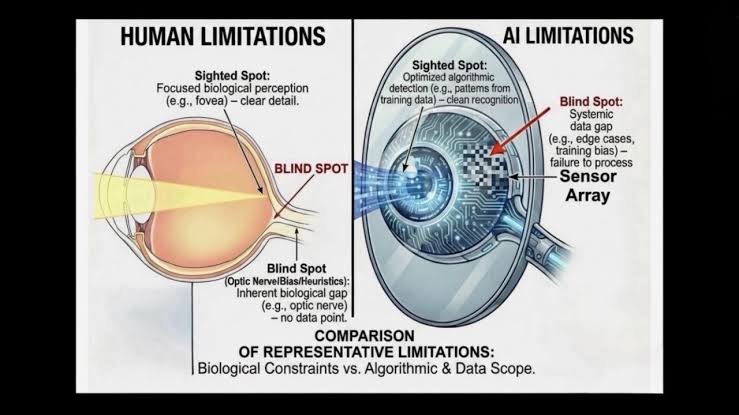
AI can sometimes inherit limitations from the data used to train or operate it.
If the underlying research literature contains systematic gaps or biases, an AI system may reproduce them instead of identifying them.
For example, a research field might have much more evidence from certain geographic regions than others. An AI model could interpret the available evidence as representative when it actually reflects a narrower research environment.
This makes AI Research Blind Spots particularly important when studying populations, environments, or conditions that are not equally represented in scientific datasets.
Researchers should ask not only, “What does the data show?” but also, “Who or what is missing from the data?”
4. AI Research Blind Spots Can Confuse Correlation With Meaning
AI is very good at detecting patterns.
However, finding a relationship between two variables does not automatically explain why that relationship exists.
A dataset may show that two variables frequently appear together, but other factors may be responsible for the connection.
For scientific research, this distinction is extremely important.
AI can help researchers identify possible relationships, but researchers still need appropriate experiments, statistical analysis, and scientific reasoning to determine whether a relationship is meaningful.
A pattern should therefore be treated as a research clue, not automatically as a proven explanation.
5. AI Research Blind Spots Can Overlook Negative Results
Scientific research does not consist only of successful experiments.
Failed experiments, unexpected results, and studies that do not support a hypothesis can also provide valuable information.
However, negative or less-visible results may receive less attention in scientific literature. If an AI system primarily analyzes highly visible or frequently cited studies, it may develop an incomplete picture of what researchers have actually discovered.
This can create an important blind spot.
Scientists should therefore consider unsuccessful experiments, contradictory evidence, and limitations when evaluating AI-generated research summaries.
6. AI Research Blind Spots Can Miss New Scientific Ideas
AI learns from existing information.
That creates a difficult question: can a system trained heavily on previous research reliably recognize ideas that are genuinely outside established scientific patterns?
AI can combine existing concepts in creative ways and suggest potentially valuable hypotheses. However, a completely new idea may have limited supporting literature.
As a result, an AI system might underestimate an unusual research direction simply because it does not closely resemble existing knowledge.
Scientists should therefore avoid using popularity or similarity as the only measure of research importance.
Sometimes the most valuable question is the one that looks different from everything else.
7. AI Research Blind Spots Can Hide Uncertainty
Scientific evidence is rarely perfectly certain.
Studies can have small samples, methodological limitations, conflicting findings, measurement errors, or conditions that restrict how widely the results can be applied.
An AI-generated summary may make complicated evidence sound simpler than it really is.
This is one of the most important AI Research Blind Spots because scientific uncertainty can disappear when complex findings are compressed into short explanations.
Researchers should examine confidence levels, study limitations, competing explanations, and the quality of the underlying evidence.
AI should help researchers understand uncertainty rather than hide it.
AI Research Blind Spots: A Simple Risk Framework
The following framework is an illustrative model, not a statistical measurement. It shows the main areas scientists can check when reviewing AI-assisted research.
| Blind Spot | Main Question | Recommended Check |
|---|---|---|
| Missing data | What information is absent? | Check database coverage |
| Context | Could the meaning be different? | Read the original paper |
| Bias | Is the evidence representative? | Compare different sources |
| Correlation | Does the pattern prove causation? | Review methodology |
| Negative results | Are failed studies included? | Search contradictory evidence |
| Novel ideas | Could AI overlook unusual research? | Explore alternative hypotheses |
| Uncertainty | Are limitations clearly shown? | Examine original evidence |
This framework can be used as a practical checklist rather than a scientific ranking. Different research projects will have different risks.
How Scientists Can Reduce AI Research Blind Spots
Reducing AI Research Blind Spots starts with using high-quality and diverse research sources.
Scientists should compare AI-generated findings with original papers instead of relying entirely on summaries. Important claims should be verified against primary evidence.
It is also useful to use multiple search strategies. A single keyword may fail to find relevant research because scientists in another discipline use different terminology.
Researchers can also deliberately search for contradictory evidence. Instead of asking only for studies supporting an idea, they can look for studies that challenge it.
Another important step is human review. Researchers understand experimental context, scientific limitations, and disciplinary terminology in ways that automated systems may not always capture.
Finally, AI-generated hypotheses should be tested rather than accepted automatically. A promising idea becomes scientifically valuable only when appropriate evidence supports it.
AI Research Blind Spots: Positive and Negative Sides
There is a positive side to understanding AI Research Blind Spots.
When researchers know where AI can fail, they can design better workflows. Instead of asking AI to make final scientific decisions, they can use it for searching, organizing, comparing, summarizing, and generating possibilities.
This creates a human-AI research partnership.
The negative side is that overconfidence in AI can create serious problems. A researcher who assumes that AI has found everything may overlook important evidence.
Therefore, the goal should not be to eliminate human involvement. The goal should be to combine AI’s ability to process information with human scientific judgment.
Frequently Asked Questions
What are AI Research Blind Spots?
AI Research Blind Spots are areas of information, context, evidence, or uncertainty that AI may overlook or misunderstand during scientific research.
Why do AI Research Blind Spots happen?
They can happen because of incomplete datasets, biased sources, ambiguous terminology, missing studies, limited context, or weaknesses in AI interpretation.
Can AI completely eliminate research gaps?
No. AI can help identify potential gaps, but it cannot guarantee that every missing area of science has been discovered.
How can scientists check AI-generated research findings?
Scientists can verify important claims using original research papers, reliable datasets, independent sources, appropriate statistical methods, and expert review.
Is AI dangerous for scientific research?
AI itself is a research tool. The main concern is inappropriate reliance on AI-generated information without sufficient verification.
Can AI discover things humans miss?
Yes, AI can identify patterns across very large datasets that humans might overlook. However, it can also miss information that requires context, judgment, or knowledge outside its available data.
Conclusion
AI Research Blind Spots are an important issue for the future of scientific research. Artificial intelligence can analyze huge amounts of information, identify patterns, organize research, and suggest new questions. Yet these strengths do not mean AI can see everything.
Missing data, hidden bias, misunderstood context, correlation problems, overlooked negative results, unusual scientific ideas, and hidden uncertainty can all create blind spots.
The best solution is not to avoid AI. Instead, scientists should use AI carefully and combine its speed with human expertise, critical thinking, and independent verification.
When researchers understand the limitations of AI, they can turn AI Research Blind Spots from a weakness into an opportunity for stronger, more transparent, and more reliable scientific discovery.