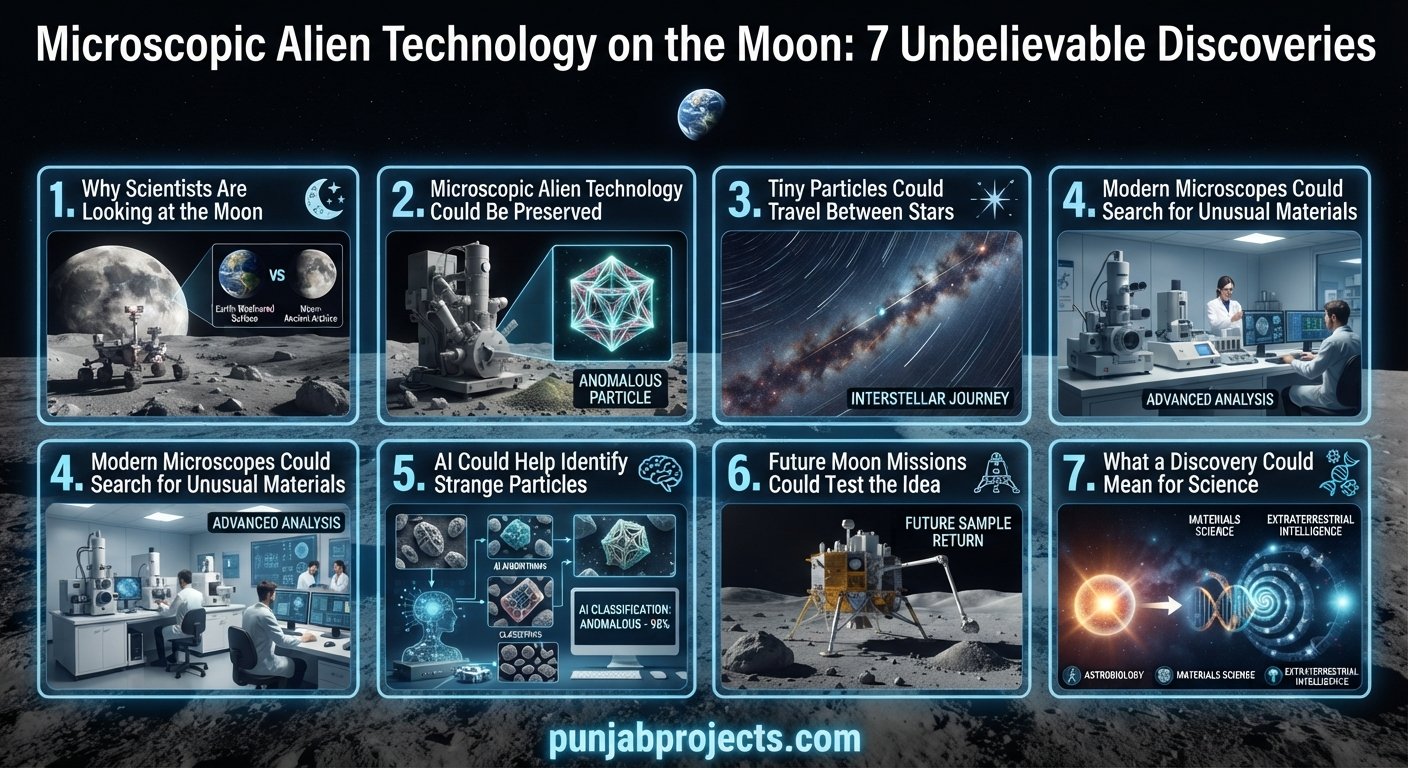
Microscopic Alien Technology on the Moon: 7 Unbelievable Discoveries
The search for extraterrestrial intelligence is entering a fascinating new stage. For decades, scientists have mainly searched the sky for radio signals, laser emissions, unusual astronomical objects, or other signs of advanced civilizations. In 2026, researchers have proposed another unusual possibility: looking directly into the Moon’s ancient soil.
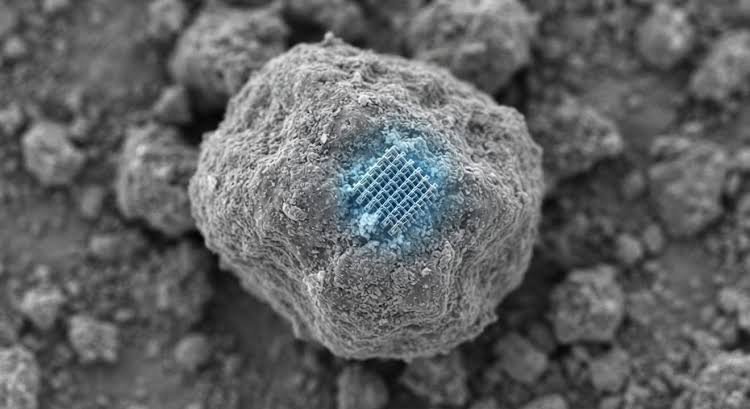
Microscopic Alien Technology on the Moon is not a confirmed discovery. Instead, it describes a new research idea in which scientists could search lunar regolith for extremely small engineered particles that might have traveled through interstellar space and survived for extremely long periods. A September 2026 announcement from the SETI Institute described a new quantitative framework for testing this possibility.
The idea is especially interesting because the Moon has no atmosphere, flowing water, or active plate tectonics like Earth. Its surface can therefore preserve ancient material for very long periods. Researchers suggest that this makes lunar regolith a potential archive for studying the history of material arriving from space.
Table of Contents
- Why Scientists Are Looking at the Moon
- Microscopic Alien Technology Could Be Preserved in Lunar Soil
- Tiny Particles Could Travel Between Stars
- Modern Microscopes Could Search for Unusual Materials
- AI Could Help Identify Strange Particles
- Future Moon Missions Could Test the Idea
- What a Discovery Could Mean for Science
- Frequently Asked Questions
- Conclusion
1. Why Scientists Are Looking at the Moon
The Moon may appear to be a lifeless and dusty world, but its surface has an unusual scientific advantage. It has been exposed to material from space for billions of years. Without an atmosphere or flowing water, many particles can remain on or below the surface instead of being quickly destroyed.
Microscopic Alien Technology on the Moon This makes the Moon different from Earth. On Earth, wind, rain, oceans, biological activity, earthquakes, and geological processes constantly change the surface. Ancient particles can become buried, altered, or destroyed.
The Moon does not experience these processes in the same way. As a result, researchers are considering whether lunar soil could preserve tiny particles that arrived from distant parts of the galaxy.
The proposed search for Microscopic Alien Technology on the Moon therefore focuses on material evidence rather than signals. Instead of asking whether an alien civilization is transmitting a message today, scientists could ask whether an ancient technological civilization ever left durable microscopic material behind.
2. Microscopic Alien Technology Could Be Preserved in Lunar Soil
One of the most fascinating parts of this research is the idea that technological material could be extremely small.
Microscopic Alien Technology on the Moon Scientists are not necessarily looking for large spacecraft, buildings, or obvious machines. Instead, the proposed research considers micron-scale or submicron particles. Such particles could potentially be created as technological waste, fragments, or other durable artificial material.
The 2026 study examines whether engineered particles could survive the journey through interstellar space and eventually become incorporated into lunar regolith. The researchers developed models involving interstellar transport, particle survival, lunar geology, and impact processes.
This makes Microscopic Alien Technology on the Moon a very different concept from traditional alien searches.
A particle would not need to look like a miniature spaceship. It might instead have unusual composition, structure, shape, or material characteristics that are difficult to explain through known natural processes.
Microscopic Alien Technology on the Moon However, scientists would need to be extremely careful. Finding an unusual particle would not automatically prove that it was manufactured by extraterrestrial intelligence. Natural space environments can also create strange and unexpected materials.
3. Tiny Particles Could Travel Between Stars
The idea becomes even more futuristic when interstellar travel is considered.
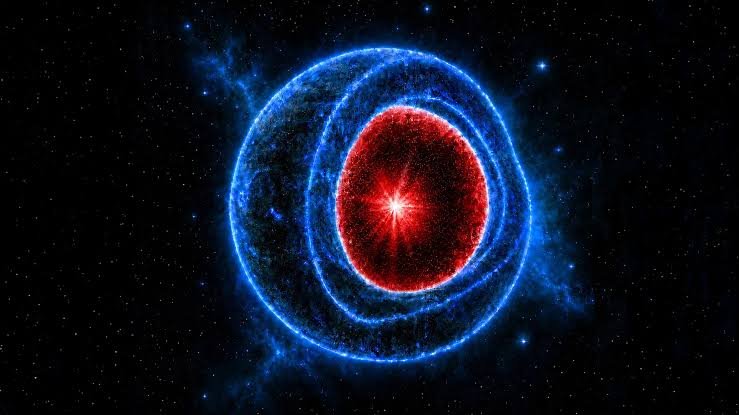
Space between stars is not completely empty. It contains gas, dust, radiation, and extremely small particles. The 2026 research investigates how microscopic particles could move through the interstellar medium and whether some durable particles could survive long journeys.
The researchers model particles with sizes around the submicron scale and examine processes such as gas drag, sputtering, radiation pressure, and heliospheric filtering.
According to the study, some refractory particles could potentially survive very long journeys under certain conditions. Microscopic Alien Technology on the Moon This does not mean that alien technology has actually reached the Moon. Instead, it provides a physical basis for asking whether such material could survive long enough to become detectable.
That distinction is important.
Microscopic Alien Technology on the Moon is currently a scientific hypothesis and search strategy, not evidence that extraterrestrial technology has already been discovered. The SETI Institute explicitly states that the research reports no evidence of extraterrestrial technology.
4. Modern Microscopes Could Search for Unusual Materials
Technology has also changed the way scientists can investigate tiny particles.
Modern microscopy can reveal structures that would have been impossible to study in detail decades ago. Researchers can combine microscopy with spectroscopy, tomography, materials analysis, and other laboratory techniques.
This creates a potential pathway for investigating lunar samples at extremely small scales.
Microscopic Alien Technology on the Moon A future sample could be separated into different particle sizes and examined for unusual characteristics. Scientists could then compare those particles with known lunar minerals, meteorite material, industrial materials, and naturally produced cosmic dust.
The search for Microscopic Alien Technology on the Moon would therefore require more than simply finding something strange under a microscope.
Researchers would need multiple independent measurements to determine whether a particle has properties that are difficult to explain naturally.
This is one reason the proposed research is scientifically interesting. It attempts to turn an unusual alien-search concept into something that can actually be tested with laboratory equipment.
5. AI Could Help Identify Strange Particles
Another futuristic part of the research is the possible use of artificial intelligence.
Lunar samples could contain enormous numbers of tiny particles. Examining every particle manually would be difficult and time-consuming. AI-assisted imaging could potentially help researchers classify particles and identify samples that deserve closer investigation.
A machine-learning system could be trained using large collections of known lunar and cosmic materials. It could then help scientists identify particles with unusual shapes, structures, or compositions.
Microscopic Alien Technology on the Moon This does not mean AI would independently decide that something is alien.
Instead, AI could act as a screening tool. It could reduce the number of particles that scientists need to investigate in detail.
The proposed framework specifically discusses combining machine-vision techniques with laboratory forensic methods. This combination could make large-scale searches more practical.
In the future, Microscopic Alien Technology on the Moon could therefore become a multidisciplinary research field involving planetary science, artificial intelligence, materials science, astronomy, and astrobiology.
6. Future Moon Missions Could Test the Idea
The next major step would be obtaining and carefully studying more lunar material.
Microscopic Alien Technology on the Moon The SETI Institute says future lunar samples returned by missions such as Artemis and Chang’e could potentially help test this approach. Researchers could also investigate lunar material directly on the Moon as exploration expands.
This could create an important advantage.
Instead of relying entirely on observations from Earth, scientists could eventually examine lunar regolith using instruments located on the lunar surface.
Microscopic Alien Technology on the Moon A robotic system could collect samples, separate particles, scan them with advanced instruments, and transmit interesting results to researchers.
Future sample-return missions could provide another opportunity. Scientists on Earth could use much larger and more powerful laboratory equipment to investigate carefully selected particles.
Therefore, Microscopic Alien Technology on the Moon could become easier to test as lunar exploration becomes more advanced.
7. What a Discovery Could Mean for Science
If scientists eventually discovered a particle with strong evidence of artificial extraterrestrial origin, the scientific impact would be enormous.
It could provide physical evidence that technological activity existed beyond Earth. Unlike a mysterious radio signal, a physical particle could potentially be examined repeatedly in laboratories around the world.
Scientists could study its chemical composition, microscopic structure, manufacturing characteristics, and possible origin.
It could also change how researchers think about the history of technology in the galaxy.
However, such a discovery would require extraordinary evidence. Researchers would need to eliminate natural explanations and contamination from human spacecraft, equipment, laboratories, and terrestrial materials.
This is particularly important because humans have already sent spacecraft to the Moon. Any future investigation of Microscopic Alien Technology on the Moon would therefore need strict contamination controls and detailed records of every sample.
Even finding nothing would still produce useful scientific information.
The 2026 study explains that examining a defined volume of lunar regolith could place quantitative limits on the amount of long-lived artificial particulate material that technological civilizations might have produced.
That means the research does not depend entirely on finding aliens to be scientifically useful.
Frequently Asked Questions
Is Microscopic Alien Technology on the Moon real?
There is currently no confirmed evidence of alien technology on the Moon. The phrase describes a proposed research strategy for searching lunar regolith for microscopic technosignatures.
Did scientists discover alien particles in 2026?
No. The 2026 research does not report a discovery of extraterrestrial technology. It presents a framework for testing whether microscopic artificial particles could survive interstellar travel and become preserved in lunar soil.
Why is the Moon useful for this research?
The Moon lacks an atmosphere, flowing water, and Earth-like active geological processes. Its surface can therefore preserve ancient material for extremely long periods.
Could AI find alien technology?
AI could potentially help researchers screen and classify huge numbers of microscopic particles. However, AI alone would not prove that a particle was extraterrestrial. Laboratory testing and independent scientific verification would still be required.
What are technosignatures?
Technosignatures are observable signs of technology created or used by extraterrestrial beings. They can include signals, unusual astronomical observations, or physical artifacts.
What happens if scientists find nothing?
A null result would still be scientifically useful. It could help researchers place limits on how much durable artificial material might have been produced by technological civilizations and survived in the lunar environment.
Conclusion
Microscopic Alien Technology on the Moon represents one of the more unusual directions in the modern search for extraterrestrial intelligence. Instead of looking only toward distant stars, researchers are considering whether the Moon itself could preserve microscopic evidence from the wider galaxy.
The idea remains unproven, and no alien technology has been discovered through this method. Nevertheless, the 2026 research provides a quantitative framework for testing the possibility using lunar soil, advanced microscopy, materials analysis, and AI-assisted techniques.
The most exciting part is that the concept can be tested. Future lunar exploration could provide increasingly detailed samples and instruments, allowing scientists to investigate whether the Moon contains unusual particles that deserve deeper study.
For now, the Moon remains an ancient archive waiting to be examined more closely. Whether that archive contains only natural cosmic material or something far more extraordinary is a question future research may help answer.