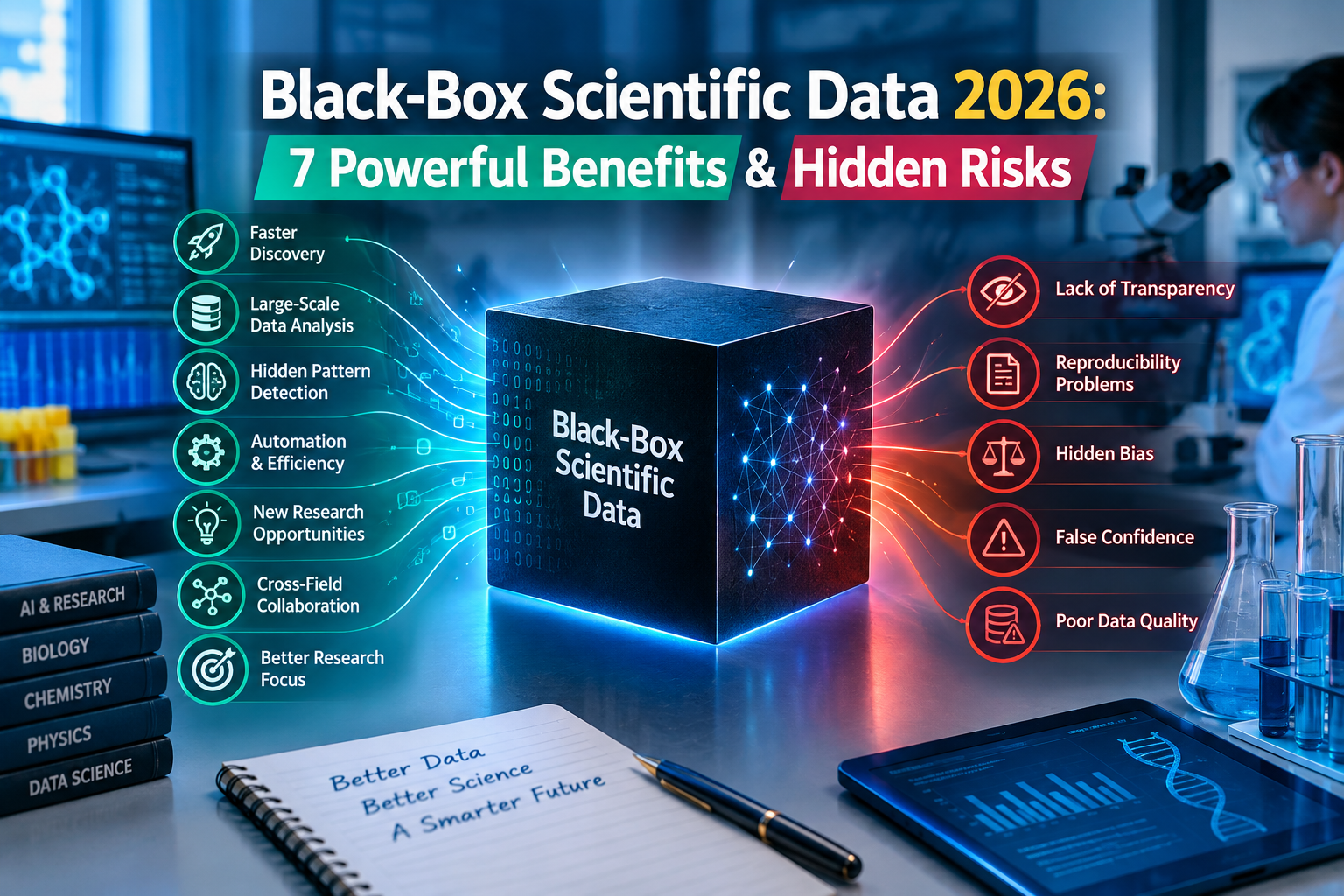
Black-Box Scientific Data 2026: 7 Powerful Benefits & Hidden Risks
Black-Box Scientific Data 2026 is becoming an important research topic as artificial intelligence, automated laboratories, and advanced scientific software become more common. Modern researchers can now generate, process, and analyze huge amounts of information faster than ever. However, some scientific data can be difficult to understand because the systems that create or process it may not clearly show how every result was produced. This creates both powerful opportunities and serious research challenges.

Table of Contents
- What Is Black-Box Scientific Data?
- 7 Powerful Benefits of Black-Box Scientific Data
- Hidden Risks of Black-Box Scientific Data
- Future of Black-Box Scientific Data
- FAQs
- Conclusion
What Is Black-Box Scientific Data?
Black-Box Scientific Data refers to scientific information produced or transformed by systems where the complete process behind the result is difficult to inspect, understand, or reproduce. The term “black box” is commonly used when the input and output are visible, but the internal process is unclear.
In modern research, this situation can appear in artificial intelligence models, automated experiments, complex simulations, laboratory instruments, and large data-processing systems. A researcher may receive a useful prediction or scientific result without being able to easily explain every step that produced it.
This does not automatically mean that the data is incorrect. Instead, the main concern is transparency and traceability. Researchers need to know where data came from, how it was processed, what assumptions were used, and whether another researcher can reproduce the result.
Black-Box Scientific Data and AI Research
Artificial intelligence has made this issue more important. Machine-learning systems can identify patterns across millions of scientific observations. They can also detect relationships that would be difficult for humans to find manually.
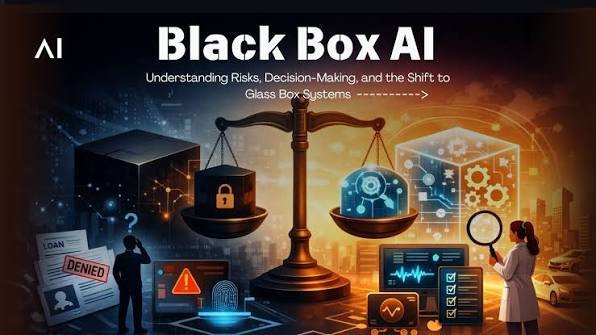
However, highly complex models may provide accurate predictions without offering an easy explanation of their internal reasoning. In scientific research, this can become a problem when researchers need strong evidence rather than only a prediction.
For example, an AI system may identify a possible material with useful properties. The prediction could be valuable, but researchers still need experiments and supporting evidence before treating the prediction as a reliable scientific discovery.
7 Powerful Benefits of Black-Box Scientific Data
1. Black-Box Scientific Data Can Process Huge Datasets
One major benefit of Black-Box Scientific Data systems is their ability to handle enormous datasets. Modern experiments can generate information at a scale that is difficult for humans to analyze manually.
AI systems can process large collections of images, molecular structures, sensor measurements, genomic information, and experimental results. This can help researchers identify patterns much faster.
Instead of spending months examining data manually, scientists can use computational systems to narrow down important relationships and potential discoveries.
Black-Box Scientific Data and AI Research
Research can become faster when automated systems analyze information continuously. A computational model can compare thousands or millions of possibilities in a relatively short period Black-Box Scientific Data 2026.

This is especially useful in fields such as materials science, chemistry, biology, astronomy, and drug research. Researchers can use predictions to decide which experiments deserve further attention.
The technology does not remove the need for scientists. Instead, it can help scientists focus their time on the most promising research directions.
3. Black-Box Scientific Data Can Detect Hidden Patterns
Some relationships are too complicated to identify through traditional analysis. Machine-learning systems can examine many variables simultaneously and identify patterns that may not be obvious to researchers Black-Box Scientific Data 2026.
This creates an opportunity for scientific discovery. A system might identify a relationship between different measurements and suggest a new research question.
The important step is verification. A detected pattern should be tested before it becomes a scientific conclusion.
4. Black-Box Scientific Data Can Support Automated Experiments
Automation is changing laboratory research. Robotic systems can perform repeated experiments, collect measurements, and send results to computational models Black-Box Scientific Data 2026.
In an advanced workflow, the model can analyze the new results and suggest the next experiment. This creates a research cycle in which data continuously influences experimental decisions.
Such systems can reduce repetitive laboratory work and potentially improve the speed of experimental research.
5. Black-Box Scientific Data Can Improve Research Efficiency
Scientific projects often involve large amounts of repetitive data preparation and analysis. Automated systems can reduce some of this workload Black-Box Scientific Data 2026.
Researchers can use computational tools to organize observations, compare experimental outcomes, detect unusual results, and prioritize important datasets.
As a result, scientists may spend more time developing research questions and interpreting meaningful findings rather than performing every repetitive analytical task manually.
6. Black-Box Scientific Data Can Reveal Research Opportunities
Another potential benefit is the discovery of new research opportunities. When an AI system identifies an unusual relationship, researchers can investigate it further.
This can lead to new hypotheses, experiments, or research directions.
The value is particularly high when the system is used as a discovery assistant rather than a final decision-maker. Human researchers can evaluate the result, design experiments, and determine whether the observation has scientific meaning Black-Box Scientific Data 2026.
7. Black-Box Scientific Data Can Connect Different Research Fields
Large computational systems can combine information from different scientific areas. Data from chemistry, physics, biology, materials science, and engineering can sometimes be analyzed together.
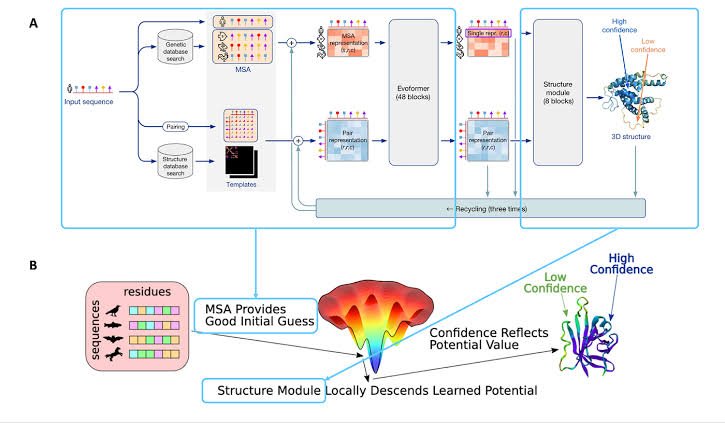
This can encourage interdisciplinary research.
For example, a materials research project may combine information about chemical structures, physical properties, manufacturing conditions, and computational predictions. Combining these datasets can reveal relationships that might remain hidden when each field works separately Black-Box Scientific Data 2026.
Black-Box Scientific Data: Benefits at a Glance
| Benefit | Research Value | Main Requirement |
|---|---|---|
| Large-scale analysis | Faster data processing | Reliable datasets |
| Pattern detection | New research clues | Scientific validation |
| Automated experiments | Less repetitive work | Proper controls |
| Faster discovery | Better research prioritization | Human review |
| Data integration | Cross-field insights | Compatible data |
| Research efficiency | Less manual analysis | Good documentation |
| New hypotheses | More research opportunities | Experimental testing |
Hidden Risks of Black-Box Scientific Data
The benefits are important, but Black-Box Scientific Data also creates several risks. These risks become more serious when researchers treat automated outputs as final scientific evidence Black-Box Scientific Data 2026.
Black-Box Scientific Data Can Reduce Transparency
The biggest concern is transparency. If researchers cannot understand how a system produced a result, explaining the scientific conclusion becomes difficult.
Scientific research depends heavily on evidence and reasoning. A result that cannot be properly explained may be harder for other scientists to evaluate Black-Box Scientific Data 2026.
Black-Box Scientific Data Can Create Reproducibility Problems
Reproducibility is a central part of science. Other researchers should be able to repeat a method and investigate whether they obtain similar results.
Black-box systems can make this difficult when important information about the model, dataset, software version, parameters, or processing pipeline is unavailable.
A prediction may look impressive but still be difficult to reproduce Black-Box Scientific Data 2026.
Black-Box Scientific Data Can Carry Hidden Bias
AI systems learn from data. If the original dataset contains errors, gaps, or biases, the resulting model may reproduce or amplify those problems.
This is especially important when datasets represent only a limited part of a scientific population or environment Black-Box Scientific Data 2026.
Researchers therefore need to examine not only the final result but also the data used to produce it.
Black-Box Scientific Data Can Produce False Confidence
A highly accurate-looking prediction can create a false sense of certainty. Researchers may assume that a sophisticated system must be correct simply because it uses advanced technology.
That assumption can be dangerous Black-Box Scientific Data 2026.
AI-generated results should be treated as evidence or research leads rather than automatically accepted as scientific facts.
Black-Box Scientific Data Can Hide Data Quality Problems
A complex system can sometimes make poor-quality data appear scientifically meaningful. Missing values, incorrect measurements, inconsistent formats, or flawed experimental records can influence the final output.
Good research therefore requires strong data management before advanced analysis begins.
Black-Box Scientific Data: Simple Risk Comparison
The following conceptual graph shows how major concerns can increase when transparency and documentation decrease Black-Box Scientific Data 2026.
Research Risk Level
Transparency ████████████████████ Low Risk
Good Documentation █████████████████ Low Risk
Human Validation ███████████████ Low–Medium Risk
Limited Explanation ███████████ Medium Risk
Poor Traceability ███████████████████ High Risk
This is a conceptual research illustration, not a measured statistical dataset.
How Researchers Can Use Black-Box Scientific Data Safely
Researchers do not necessarily need to avoid black-box systems. Instead, they can build stronger verification practices around them.
First, researchers should record the source of the data and document important processing steps. Model versions, software versions, parameters, and experimental conditions can also be preserved where possible Black-Box Scientific Data 2026.
Second, important AI-generated findings should be independently tested. If an algorithm predicts a new scientific relationship, researchers should design experiments or alternative analyses to determine whether the relationship is real.
Third, researchers should maintain a clear distinction between prediction and proof. A machine-generated result can be an excellent starting point, but scientific validation is still required Black-Box Scientific Data 2026.
Finally, research teams should preserve enough information for another scientist to understand and evaluate the workflow. Better documentation can reduce the risks associated with complex systems Black-Box Scientific Data 2026.
Black-Box Scientific Data 2026 The Future of Black-Box Scientific Data
The future of Black-Box Scientific Data will likely be connected to more advanced AI systems, automated laboratories, and increasingly complex scientific datasets.
As research becomes more automated, the ability to trace a scientific result back to its original data and processing steps will become increasingly valuable.
The goal should not simply be to create more powerful AI systems. Researchers also need systems that can provide better explanations, preserve data history, document experimental decisions, and support reproducibility.
This could lead to a new research environment where AI performs complex analysis while scientists maintain responsibility for validation and interpretation Black-Box Scientific Data 2026.
In the long term, the strongest scientific workflows may combine automation with transparent data practices. This approach can provide the speed of AI while protecting important principles of scientific research.
FAQs About Black-Box Scientific Data
What is Black-Box Scientific Data?
Black-Box Scientific Data is scientific information generated or processed through systems where the complete internal process behind the result is difficult to understand or inspect Black-Box Scientific Data 2026.
Why is Black-Box Scientific Data important in 2026?
It is important because AI, automated experiments, and large-scale scientific computing are becoming more common. Researchers increasingly need ways to balance powerful automated analysis with transparency and reproducibility.
Is Black-Box Scientific Data always unreliable?
No. A black-box system can produce useful and accurate results. The main issue is that difficult-to-explain results require careful validation before they are accepted as scientific evidence Black-Box Scientific Data 2026.
How can researchers reduce the risks?
Researchers can improve documentation, preserve data and model information, conduct independent validation, and clearly separate AI predictions from experimentally confirmed findings.
Can Black-Box Scientific Data help scientific discovery?
Yes. It can help process large datasets, identify hidden patterns, prioritize experiments, and generate new research possibilities. However, scientific validation remains essential Black-Box Scientific Data 2026.
Conclusion
Black-Box Scientific Data represents both an opportunity and a challenge for modern research. AI and automated scientific systems can process enormous datasets, identify hidden patterns, speed up experiments, and create new research possibilities. At the same time, limited transparency, reproducibility problems, hidden bias, and poor data traceability can create serious concerns.
The best approach is not to reject complex scientific systems but to use them responsibly. Strong documentation, human oversight, independent testing, and transparent research practices can make automated scientific workflows more trustworthy. As AI becomes a larger part of scientific discovery, understanding the benefits and hidden risks of Black-Box Scientific Data will become increasingly important for researchers Black-Box Scientific Data 2026.