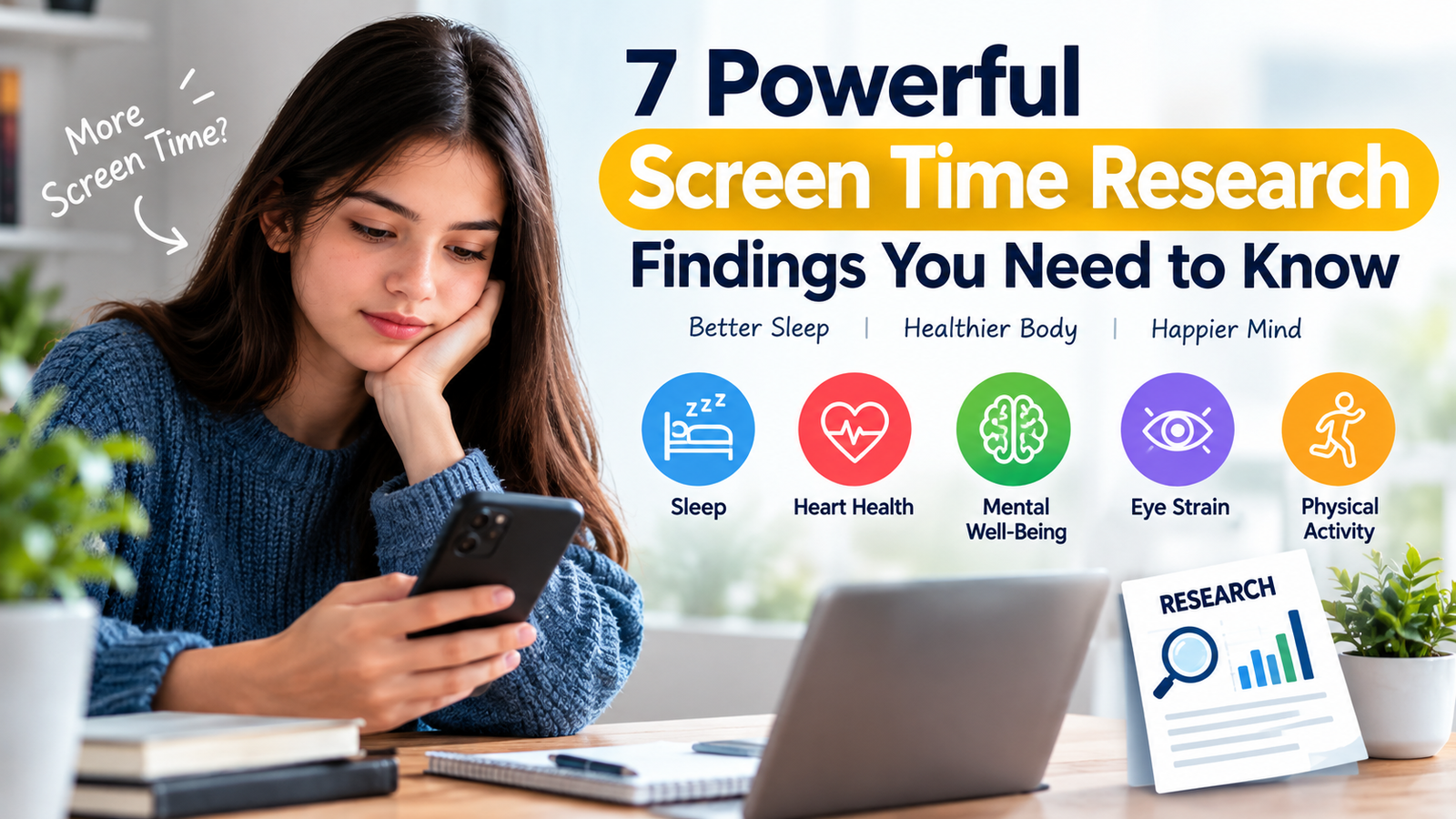
7 Powerful Screen Time Research Findings You Need to Know
In today’s digital world, screens have become an important part of everyday life. From smartphones and laptops to televisions and tablets, people use digital devices for work, education, entertainment, shopping, and communication. Screen Time Research is helping researchers understand how this growing exposure may affect sleep, physical activity, mental well-being, and everyday habits. While screens provide many useful benefits, spending excessive amounts of time on them may become a concern when it replaces sleep, exercise, outdoor activities, or face-to-face interaction.
The good news is that screen use does not automatically mean poor health. The purpose of modern Screen Time Research is not simply to tell people to stop using technology. Instead, researchers are examining how long people use screens, what they do on them, when they use them, and how screen use fits into their overall lifestyle. Understanding these differences can help people make smarter and healthier choices without completely giving up the technology they depend on.
Table of Contents
- Screen Time Research Shows Why Long Screen Sessions Matter
- Screen Time Research Reveals a Strong Sleep Connection
- Screen Time Research Highlights Cardiovascular Concerns
- Screen Time Research Examines Mental Well-Being
- Screen Time Research Shows Why Digital Eye Strain Matters
- Screen Time Research Explains Why Screen Type Matters
- Screen Time Research Supports a More Balanced Digital Routine
- Conclusion: What Screen Time Research Really Tells Us
Screen Time Research Shows Why Long Screen Sessions Matter
One of the clearest themes in Screen Time Research is the relationship between prolonged screen-based sedentary behavior and health. Spending long periods sitting in front of a computer, television, or phone can reduce the amount of time a person spends walking or performing other physical activities. An overview of systematic reviews found that higher levels of sedentary behavior were associated with several unfavorable health outcomes, although the strength and certainty of evidence differed between outcomes.
This does not mean that every hour spent at a desk or on a phone will directly cause a health problem. The overall lifestyle matters. Someone who works on a computer for several hours but regularly walks, exercises, stands, and takes breaks has a different routine from someone who spends most of the day sitting and rarely moves.
This distinction is important because modern life often requires screen use. Students may need laptops for assignments, employees may work online, and families may depend on smartphones for communication. Rather than treating all screen exposure as harmful, researchers increasingly look at the amount, purpose, and context of screen use.
Long uninterrupted sessions may be particularly worth watching. Taking short movement breaks during computer work can help interrupt extended periods of sitting and make a digital routine more active.
Screen Time Research Reveals a Strong Sleep Connection
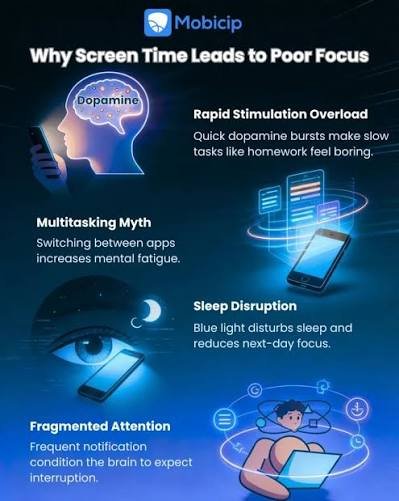
Sleep is one of the most widely studied topics in Screen Time Research. Smartphones, tablets, televisions, gaming devices, and computers can keep people mentally engaged late into the evening. Notifications, entertainment, social media, games, and online conversations can also make it easier to delay bedtime.
A recent systematic review and meta-analysis examining more than 500,000 participants found that additional daily screen exposure was associated with slightly shorter sleep duration and increased odds of several sleep problems. The researchers also identified relationships with delayed bedtime and difficulty falling asleep.
The findings should still be interpreted carefully. Screen use is only one possible factor affecting sleep. Stress, caffeine, work schedules, school responsibilities, bedroom conditions, and personal sleep habits can also influence how well someone sleeps.
Nevertheless, the relationship is important because sleep affects many parts of daily life. Poor sleep can leave people feeling tired during the day and may make it harder to concentrate, study, work, or maintain an active routine.
Screen Time Research and Lost Sleep
The relationship between screen exposure and sleep can be illustrated using the midpoint of the shorter-sleep range reported in recent research. This chart is an educational illustration rather than an individual prediction.
The chart should not be read as a guarantee that five hours of screen use will cause exactly 20 minutes of lost sleep. It simply demonstrates how a small average association can become more noticeable as exposure increases.
Screen Time Research Highlights Cardiovascular Concerns
Another important area of Screen Time Research involves cardiovascular health. Long periods of sitting can reduce physical movement, which has encouraged researchers to investigate whether high levels of sedentary behavior are connected with cardiovascular disease.
A systematic review and meta-analysis published in 2022 found that people in the highest category of total sedentary time had greater cardiovascular disease morbidity and mortality risks compared with those in the lowest category. The researchers also examined screen-based sedentary behavior and found associations between high screen time and cardiovascular risk.
However, this evidence does not mean that screen use directly causes cardiovascular disease. Much of this research is observational, so it can identify relationships without proving direct cause and effect. People who spend large amounts of time watching television or using digital devices may also have other lifestyle characteristics that influence their health.
This is why movement remains an important part of the picture. Reducing unnecessary sitting, standing periodically, walking during breaks, and maintaining regular physical activity can help create a healthier routine around unavoidable screen use.
Screen Time Research Examines Mental Well-Being
Mental well-being has become another major focus of Screen Time Research. This subject is particularly complicated because screen use can involve very different activities. Talking to family through a video call, attending an online class, creating digital content, playing games, and endlessly scrolling through social media are all forms of screen use, but their experiences are not necessarily the same.
Recent research involving university students has reported associations between screen time and several outcomes, including depression, anxiety, stress, sleep quality, physical activity, and academic performance. However, these associations should not automatically be interpreted as proof that screen exposure caused these outcomes.
The direction of the relationship can sometimes work in more than one way. For example, a person who already feels stressed or lonely might spend more time online. In that situation, increased screen use could partly reflect an existing problem rather than being its original cause.
This is why researchers continue to examine the quality and purpose of digital activity. Healthy digital communication may provide social connection, while excessive passive consumption may contribute to a less active daily routine. More research is needed to understand these differences across different ages and populations.
Screen Time Research Shows Why Digital Eye Strain Matters
Digital eye strain is another concern discussed in Screen Time Research. People who spend many hours looking closely at computer monitors, smartphones, or tablets may experience tired eyes, dryness, blurred vision, headaches, or general discomfort.
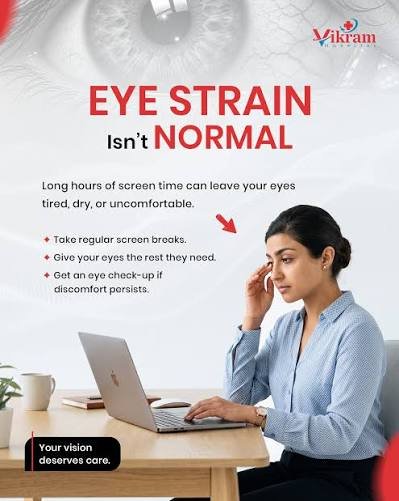
Extended close-up viewing can be particularly noticeable when someone concentrates on a screen for a long period without changing focus. Work and study can make this difficult to avoid because many daily responsibilities now depend on computers and smartphones.
The good news is that people can make simple changes to their screen habits. Looking away from the screen regularly, changing viewing distance, adjusting screen brightness, maintaining comfortable posture, and taking short breaks can make extended screen sessions more manageable.
It is also useful to consider the environment. Glare, poor lighting, an uncomfortable viewing angle, and an improperly positioned monitor can make digital work more tiring. These factors show why screen health involves more than simply counting the number of hours a person spends online.
Screen Time Research Explains Why Screen Type Matters
One of the most important ideas from Screen Time Research is that all screen time should not automatically be treated as identical.
Imagine two people spending three hours using a laptop. One person spends the time completing an online course and taking regular breaks. The other spends the entire period sitting on a sofa and watching entertainment videos. Although both have three hours of screen exposure, their activities, posture, movement, and mental engagement are completely different.
This is why researchers increasingly examine the context surrounding screen use. The content being viewed, reason for using the device, time of day, physical position, and amount of movement can all matter.
Educational screen use can help students learn. Digital communication can help families stay connected. Computers can make work more efficient. At the same time, recreational screen use that replaces physical activity or sleep may create different concerns.
Therefore, a simple statement that “all screen time is bad” does not accurately represent the research. A more useful approach is to understand which forms of screen use may be helpful, neutral, or potentially problematic in particular situations.
Screen Time Research Supports a More Balanced Digital Routine
The broader message from Screen Time Research is that balance may be more realistic than extreme restrictions. Modern society depends heavily on digital technology, so completely eliminating screens is neither practical nor necessary for most people.
A healthier approach is to examine how screens fit into the entire day. If recreational screen use is regularly pushing bedtime later, reducing nighttime use may be helpful. If work requires several hours of sitting, adding short movement breaks can interrupt prolonged sedentary periods. If entertainment dominates free time, replacing some of it with walking, exercise, hobbies, or face-to-face activities may create a more balanced routine.
The goal is not to fear technology. The goal is to prevent screens from taking over activities that are also important for health and everyday life.
Screen Time Research: What the Evidence Shows
| Research area | What research suggests | Important limitation |
|---|---|---|
| Sleep | Higher screen exposure is associated with shorter sleep and some sleep problems | Association does not prove direct causation |
| Sedentary behavior | Long periods of sitting are associated with several unfavorable health outcomes | Effects vary between populations |
| Cardiovascular health | Higher sedentary time is associated with cardiovascular risk | Much evidence is observational |
| Mental well-being | Screen exposure is associated with several mental-health outcomes in some groups | Cause and effect can be difficult to establish |
| Eye strain | Extended digital-device use is associated with eye discomfort | Individual habits and environment also matter |
Conclusion: What Screen Time Research Really Tells Us
Overall, Screen Time Research provides a more complicated picture than the simple idea that screens are either good or bad. Research has identified associations between high or prolonged screen-related sedentary behavior and areas such as sleep, physical activity, cardiovascular health, mental well-being, and digital eye strain.

At the same time, researchers continue to identify important limitations. Screen use can have different purposes, and people who spend a lot of time on devices may also differ in their sleep, physical activity, work, social lives, and other lifestyle habits. This makes it difficult to attribute every health outcome to screen exposure alone.
The most practical lesson is to develop a balanced digital routine. Taking movement breaks, protecting sleep, avoiding unnecessarily long sedentary sessions, and being intentional about recreational screen use can help people use technology without allowing it to dominate every part of the day.
As Screen Time Research continues to develop, future studies will provide more information about how screen type, timing, duration, age, and individual lifestyle factors influence health. For now, understanding the research can help people make more informed choices about how they use screens every day.
Screens are now a permanent part of modern life. The goal is not necessarily to remove them, but to use them in a way that leaves enough space for sleep, movement, relationships, learning, and a healthy daily routine.