Breakthrough Light Control Chip: New Technology Controls Light in 74 Femtoseconds
Light has always been considered one of the fastest ways to carry information. However, controlling light at extremely high speeds has remained a difficult scientific challenge. Traditional optical systems often depend on mechanical parts or electronic controls, which can limit their speed and flexibility.
A new development from researchers at Caltech has now opened an interesting direction in photonics. A Breakthrough Light Control Chip has been demonstrated that can redirect a beam of light using another beam of light in just 74 femtoseconds. One femtosecond represents one quadrillionth of a second.
The research was published in Nature Nanotechnology. The demonstrated system was able to steer light by angles of up to 13 degrees, while the direction was controlled through the spatial pattern of another light beam.
This development could become important for future optical computing, communication, sensing, and imaging technologies. However, the technology is still in the research stage and further development will be needed before practical commercial systems can be created.
Table of Contents
- What Is the Breakthrough Light Control Chip?
- Why 74 Femtoseconds Is Important
- How the New Technology Works
- The Role of the Silicon Metasurface
- Understanding the Optical Kerr Effect
- How Fast Is the New Chip?
- Potential Applications
- Why This Research Is Important
- Current Limitations
- Future Possibilities
- Frequently Asked Questions
- Conclusion
What Is the Breakthrough Light Control Chip?
The Breakthrough Light Control Chip is an experimental optical device designed to manipulate light at an extremely fast timescale. Instead of using moving mirrors or other mechanical components, the system uses one beam of light to control another.
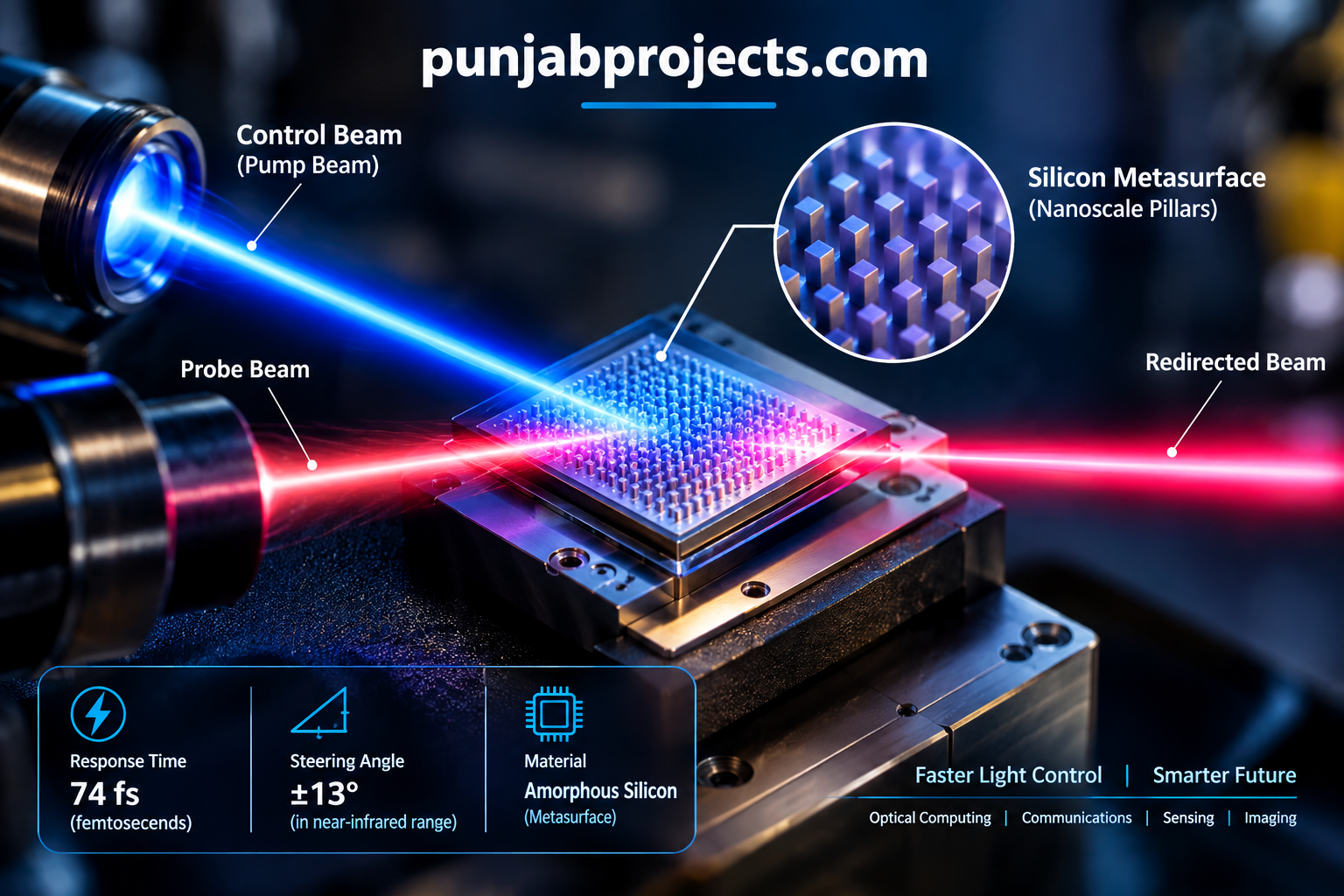
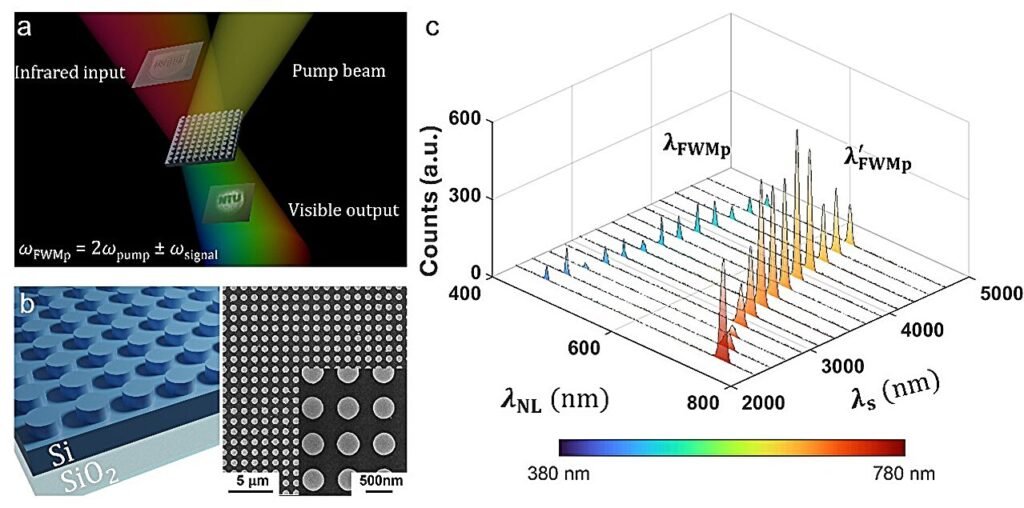
The device is based on a specially engineered metasurface. A thin layer of amorphous silicon was covered with tiny nanoscale pillars. These structures were designed so that light could interact with the material in a controlled way.
When a strong control beam is directed onto the surface, the optical properties of the material are temporarily changed. A second beam can then be redirected according to the pattern of the control beam.
As a result, the direction of light can be changed without physically moving the chip.
This approach is important because mechanical movement normally introduces delays. By contrast, an optical system can respond on a much shorter timescale.
Why 74 Femtoseconds Is Important
The most notable feature of the Breakthrough Light Control Chip is its extremely rapid response.
Researchers demonstrated light steering in as little as 74 femtoseconds. This is an extraordinarily short period of time. For comparison, a femtosecond is one millionth of a billionth of a second.
At this scale, even the movement of electrons and other microscopic processes can become important.
Breakthrough Light Control Chip The research team reported that the demonstrated steering reached angles of approximately ±13 degrees in the near-infrared range.
The significance of the experiment is not simply the number 74. Instead, it shows that optical control can take place on an ultrafast timescale without depending on conventional mechanical steering.
Understanding the Time Scale
The following graph illustrates the enormous difference between 74 femtoseconds and larger units of time. The values are mathematical conversions, not measurements of different devices.
The graph makes it easier to see why ultrafast optical control is attracting attention in modern research.
How the New Technology Works
The Breakthrough Light Control Chip uses an all-optical method for steering light.
First, a stronger beam called the pump beam is directed toward the metasurface. Its spatial pattern interacts with the nanoscale structures on the chip.
The interaction temporarily changes the optical properties of the silicon.
After that, a weaker probe beam is passed through the metasurface. Because the optical properties have been changed, the probe beam is redirected.
The direction of the output beam depends on the spatial pattern of the control beam.
Therefore, the system can be viewed as a type of optical steering mechanism in which light controls light.
This is different from traditional beam-steering systems. Mechanical systems may require mirrors or other components to physically change position. Here, the change is produced through an optical interaction.
The Role of the Silicon Metasurface
A major component of the Breakthrough Light Control Chip is its metasurface.
Metasurfaces are extremely thin structures containing many tiny features that can interact with light. Their nanoscale dimensions can be carefully engineered to influence the way light behaves.
In this experiment, silicon pillars were arranged across the surface.
Breakthrough Light Control Chip Their dimensions and spacing were designed to increase the interaction between light and the material. This was especially important because the optical effect being used is normally quite weak.
By engineering the surface at the nanoscale, the researchers were able to enhance the interaction.
The result was a compact optical structure capable of changing the direction of a light beam extremely quickly.
This demonstrates how nanotechnology can be combined with photonics to create new methods for manipulating light.
Understanding the Optical Kerr Effect
The Breakthrough Light Control Chip depends on a nonlinear optical phenomenon known as the optical Kerr effect.
The optical Kerr effect occurs when a strong beam of light produces a temporary change in a material’s refractive index.
The refractive index determines how light travels through a material. When the refractive index changes, the path taken by light can also change.
In this research, the effect was produced by the strong pump beam.
Breakthrough Light Control Chip One important feature of the effect is its rapid response. The process is associated with the electronic response of the material, allowing changes to occur extremely quickly.
However, the effect is naturally weak.
Therefore, the metasurface was carefully designed to strengthen the interaction between the light and the silicon structures.
This combination allowed the researchers to demonstrate extremely fast beam steering.
How Fast Is the New Chip?
The reported response of the Breakthrough Light Control Chip reached 74 femtoseconds.
This should be understood carefully. The reported 74-femtosecond speed was connected to the laser pulse used in the experiment. According to the researchers, the modulation speed was limited by the duration of the pump pulse.
Therefore, 74 femtoseconds should not automatically be considered the ultimate physical limit of the technology.
If shorter pulses can be used in future experiments, even faster optical modulation could potentially be investigated.
This is one reason why the research may lead to additional experiments.
Potential Applications
The Breakthrough Light Control Chip could eventually have applications across several areas of advanced technology. These possibilities are still being researched, so they should not be treated as established commercial uses.
Optical Computing
Optical computing uses light to process or transfer information.
Because light can carry information at very high speeds, ultrafast methods of manipulating optical signals could be useful in future computing systems.
A compact optical steering component could potentially become part of specialized photonic processors.
However, practical integration would require improvements in efficiency, scalability, manufacturing, and system compatibility.
High-Speed Communication
Modern communication networks already depend heavily on optical technology.
Fiber-optic systems transmit huge amounts of information using light. Additional methods for controlling optical signals could potentially improve future communication architectures.
The Breakthrough Light Control Chip could eventually contribute to systems where optical signals need to be redirected or processed at extremely high speeds.
More research will be required to determine how efficiently the concept can be integrated into real communication hardware.
Advanced Imaging
Fast manipulation of light can also be valuable for imaging systems.
If light beams can be redirected rapidly, optical scanning could potentially be performed at higher speeds.
Such technology may eventually be investigated for microscopy, advanced cameras, and other scientific imaging systems.
The present experiment, however, does not demonstrate a finished imaging product.
Sensing
Optical sensors are used in many scientific and industrial applications.
The ability to control light quickly and precisely could potentially support advanced sensing techniques.
Because the new approach is based on nanoscale structures, it may also provide opportunities for creating compact optical components.
Future Photonic Systems
The Breakthrough Light Control Chip could become relevant to future photonic circuits.
Photonic systems require components that can guide, redirect, modulate, and process light.
A very fast optical steering mechanism could potentially become one element within larger photonic architectures.
Why This Research Is Important
The Breakthrough Light Control Chip represents an interesting shift in how optical steering can be approached.
Instead of moving a physical component, the direction of light is changed through an interaction between light and a nanoscale material.
This provides several potential advantages.
First, mechanical movement is avoided.
Second, the response can occur on an extremely short timescale.
Third, the metasurface can be made very thin.
Fourth, the output direction can be influenced by the spatial pattern of the control beam.
Together, these features demonstrate a different method for manipulating light.
The research also shows the importance of combining materials science, nanotechnology, and photonics.
Current Limitations
Despite its promising results, the Breakthrough Light Control Chip remains an experimental research technology.
It should not yet be described as a commercial replacement for existing optical systems.
One limitation is the need for specialized laser pulses. The current demonstration depends on an ultrafast optical setup.
Another challenge is efficiency.
Future devices would need to operate efficiently while being integrated into practical systems.
Manufacturing could also present difficulties. Creating nanoscale structures with high precision across larger areas can be challenging.
In addition, the demonstrated steering range is limited. Although angles of up to approximately ±13 degrees were demonstrated, future applications may require wider steering ranges.
Therefore, further research will be needed before the technology can be applied broadly.
Future Possibilities
The future of the Breakthrough Light Control Chip could depend on improvements in metasurface design, materials, and ultrafast laser systems.
Researchers may investigate new materials that provide stronger nonlinear optical effects.
More advanced metasurfaces could also be designed to provide greater steering angles or improved efficiency.
Another important direction could involve shorter optical pulses.
Because the current demonstration was limited by the duration of the pump pulse, shorter pulses could potentially allow even faster operation to be explored.
The research may also contribute to future concepts involving time-varying optical materials and advanced photonic systems.
Nevertheless, these applications remain possibilities rather than established outcomes.
Frequently Asked Questions
What is a Breakthrough Light Control Chip?
A Breakthrough Light Control Chip is an experimental optical device that can redirect light using another beam of light. The demonstrated system uses a nanoscale silicon metasurface.
How fast can the chip control light?
The demonstrated optical response was as fast as 74 femtoseconds.
What is a femtosecond?
A femtosecond is one quadrillionth of a second, or 10⁻¹⁵ seconds.
What material is used in the chip?
The metasurface was made using a thin film of amorphous silicon containing nanoscale pillars.
How much can the light beam be steered?
The researchers demonstrated steering angles of approximately ±13 degrees in the near-infrared range.
Does the chip use moving mirrors?
No. The demonstrated approach uses an optical interaction rather than physically moving a mirror to redirect the beam.
Could the chip be used in computers?
The technology could potentially be investigated for future optical and photonic computing systems. However, practical computing applications have not yet been demonstrated.
Is the 74-femtosecond response the final speed?
Not necessarily. The experimental speed was limited by the duration of the pump laser pulse, so future research could investigate even faster operation.
Is the technology available commercially?
No. The research represents a laboratory demonstration, and substantial engineering and testing would be required before commercial deployment.
Conclusion
The Breakthrough Light Control Chip demonstrates an unusual and extremely fast way to manipulate light. By combining a carefully designed silicon metasurface with nonlinear optical effects, researchers were able to redirect a light beam on a 74-femtosecond timescale.
The system also demonstrated steering of approximately ±13 degrees and showed how one light beam can be used to control another without conventional mechanical movement.
Although the technology is still at the experimental stage, it could become relevant to future research in optical computing, communications, sensing, and imaging.
Most importantly, the work demonstrates that nanoscale materials can be engineered to control light at incredibly short timescales. Further improvements in materials, metasurface design, and ultrafast laser technology could determine how far this approach can eventually be developed.