7 Powerful Secrets of How Rocks Reveal Earth’s Ancient Climate
Table of Contents
- Introduction to Ancient Climate
- How Rocks Preserve Ancient Climate
- Ancient Climate Hidden in Rock Chemistry
- Ancient Climate Revealed by Oxygen Isotopes
- Ancient Climate Recorded in Sediment Layers
- Ancient Climate Hidden in Fossilized Soils
- Ancient Climate and Carbon Isotopes
- Ancient Climate Through Mineral Changes
- Why Scientists Combine Multiple Ancient Climate Clues
- New Research on Ancient Climate in 2026
- Conclusion
Introduction to Ancient Climate
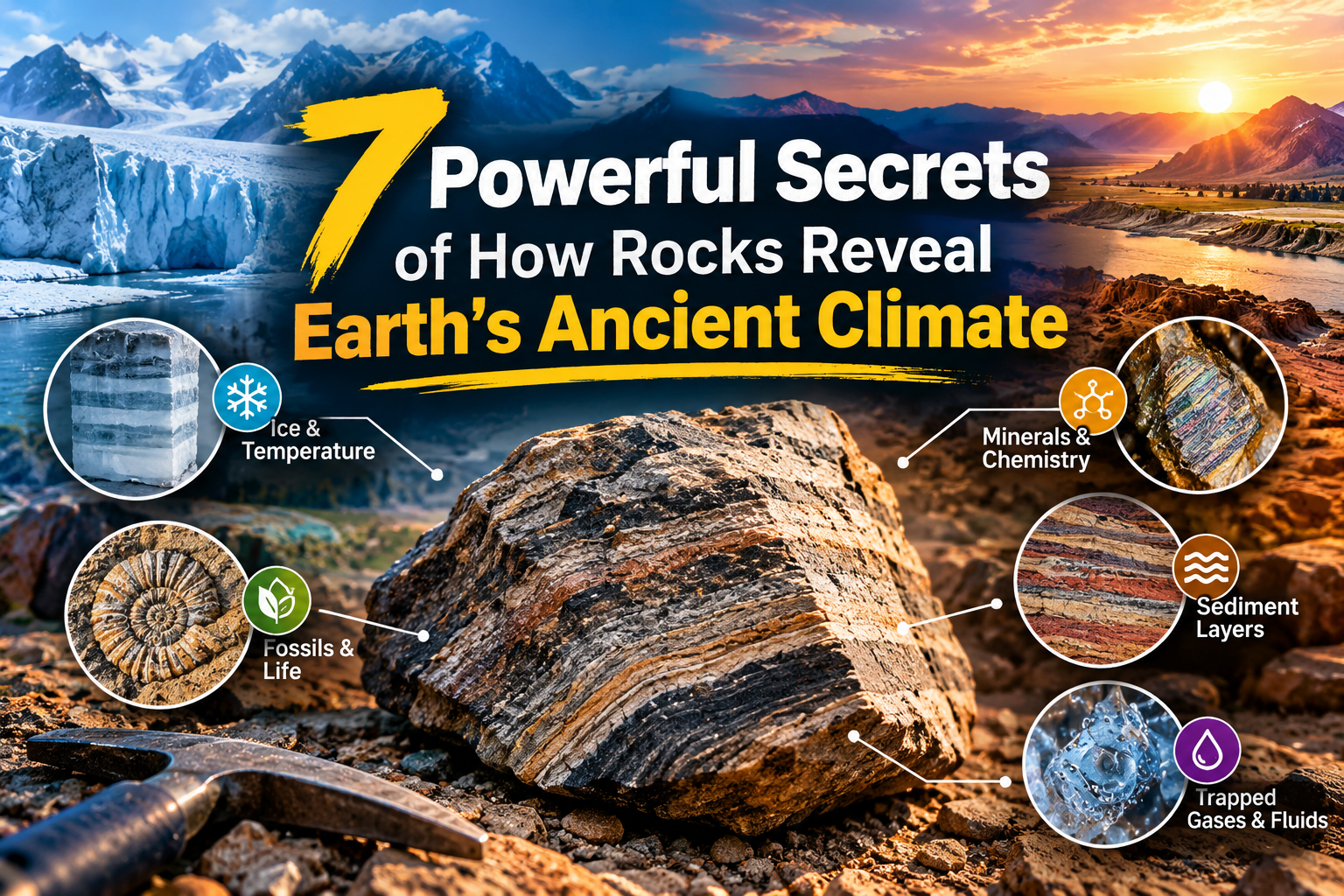
Ancient Climate may seem impossible to study because nobody was recording temperatures millions or billions of years ago. Yet rocks can preserve chemical, physical and biological clues from the environments in which they formed. Scientists use these clues, known as paleoclimate proxies, to reconstruct temperature, rainfall, ocean conditions, atmospheric chemistry and other parts of Earth’s climate history. The USGS explains that physical and chemical materials preserved in the geological record can be compared with modern climate relationships to reconstruct conditions from times before instrumental measurements existed 7 Powerful Secrets of How Rocks Reveal Earth’s Ancient Climate.
The fascinating part is that a rock does not literally “remember” weather. Instead, minerals, isotopes, sediments and fossilized soils can preserve measurable signals produced by environmental conditions. Modern laboratory techniques allow researchers to detect extremely small chemical differences and use them as pieces of a much larger climate story.
How Rocks Preserve Ancient Climate
Rocks form under particular environmental conditions. A limestone may develop from materials deposited in an ancient sea, while a sandstone may record the movement of water or wind. Soil can become buried and preserved, while volcanic minerals can provide information about the age and environment of geological layers 7 Powerful Secrets of How Rocks Reveal Earth’s Ancient Climate.
These records become useful when scientists understand how a particular property responds to climate. For example, oxygen isotopes can be related to temperature and water processes, while sediment characteristics can provide information about erosion, transportation and depositional environments.
Ancient Climate Signals Inside Geological Records
The geological record is not a single thermometer. It is more like a huge archive containing different types of evidence. Scientists may examine mineral composition, grain size, sediment structure, magnetic properties and chemical elements 7 Powerful Secrets of How Rocks Reveal Earth’s Ancient Climate.
This is why one rock sample can sometimes provide several clues. Its chemistry may reveal information about water conditions, while its surrounding sediments can indicate whether the environment was dry, wet, energetic or relatively calm.
Ancient Climate Hidden in Rock Chemistry
One of the strongest methods for studying Ancient Climate is geochemical analysis. Elements and isotopes inside rocks can preserve information about the conditions under which minerals formed 7 Powerful Secrets of How Rocks Reveal Earth’s Ancient Climate.
Scientists can examine elements such as carbon, oxygen, strontium and lithium. Their concentrations and isotope ratios can change through geological and environmental processes.
A major challenge is that chemical changes do not always have one explanation. A difference in isotope composition may reflect climate, but it can also be influenced by water chemistry, biological processes, weathering or changes that occurred after the rock formed. Researchers therefore need to carefully determine whether a signal genuinely represents ancient climate.
Ancient Climate and Geochemical Evidence
Research published in 2026 continues to improve this process. A March 2026 study examined coupled strontium and lithium isotope changes around 1.57 billion years ago and connected them with enhanced weathering and ocean oxygenation. The researchers used isotope evidence and modelling to investigate ancient Earth-system conditions 7 Powerful Secrets of How Rocks Reveal Earth’s Ancient Climate.
This demonstrates why rocks are so valuable. A tiny chemical signature can potentially reveal changes that happened hundreds of millions or even billions of years ago.
Ancient Climate Revealed by Oxygen Isotopes
Oxygen isotopes are among the best-known tools for reconstructing Ancient Climate. Oxygen exists in different isotopic forms, including oxygen-16 and oxygen-18. The relative amount of these isotopes can change during evaporation, condensation and other water-cycle processes 7 Powerful Secrets of How Rocks Reveal Earth’s Ancient Climate.
Scientists can measure oxygen isotope ratios preserved in different geological materials. When the relationship between the isotope signal and environmental conditions is understood, the measurement can provide information about ancient temperature or water conditions.
NASA explains that oxygen isotope measurements in fossil materials and other climate archives can be used to investigate past temperature and precipitation changes 7 Powerful Secrets of How Rocks Reveal Earth’s Ancient Climate.
Ancient Climate From Oxygen in Minerals
Carbonate rocks are especially interesting because their oxygen isotope composition can preserve environmental information. However, scientists must consider the chemistry of the water, the temperature at which the carbonate formed and possible changes after deposition 7 Powerful Secrets of How Rocks Reveal Earth’s Ancient Climate.
A 2026 study in Chemical Geology developed a dynamic isotope box-model approach to separate environmental processes affecting carbon and oxygen isotope signals in sedimentary carbonates. The work highlights both the usefulness and complexity of these records.
This is important because a simple isotope measurement is not automatically a perfect temperature reading. Researchers need models and additional evidence to understand what the signal actually means 7 Powerful Secrets of How Rocks Reveal Earth’s Ancient Climate.
Ancient Climate Recorded in Sediment Layers
Sedimentary rocks can preserve another fascinating form of Ancient Climate evidence. Sediment accumulates layer by layer, creating a geological history that can sometimes extend across extremely long periods.
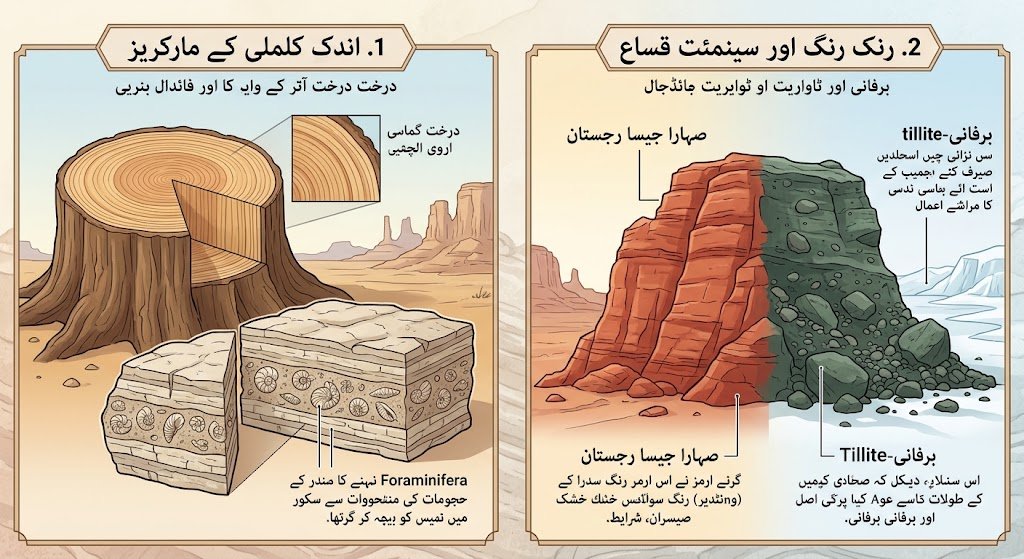
The size, shape, colour, composition and structure of sediment particles can reveal information about the environment where they were deposited. USGS research notes that sediment properties can help scientists infer conditions such as water energy, erosion, landscape changes and past environmental conditions 7 Powerful Secrets of How Rocks Reveal Earth’s Ancient Climate.
Ancient Climate in Fine and Coarse Sediments
Coarse sediment may indicate stronger transportation by water or waves, while fine particles can accumulate in quieter environments. Changes between different layers can therefore provide evidence that environmental conditions changed over time 7 Powerful Secrets of How Rocks Reveal Earth’s Ancient Climate.
Sediment colour can also provide clues. For example, mineral oxidation and organic material can influence colour, while chemical composition can reveal changes in oxygen availability and the sources of sediment.
The important point is that scientists rarely interpret one feature alone. A complete reconstruction becomes stronger when several geological signals agree 7 Powerful Secrets of How Rocks Reveal Earth’s Ancient Climate.
Ancient Climate Hidden in Fossilized Soils
Fossilized soils, known as paleosols, are another valuable archive of Ancient Climate. A soil forms at Earth’s surface and interacts with water, air, vegetation and minerals. If it is later buried and preserved, some of its characteristics can survive for millions of years.
In February 2026, the USGS published a review examining how stable isotopes in soil-formed phyllosilicates can be used to estimate ancient temperatures. The research also discussed important difficulties involving mineral selection, chemical composition and isotope-equilibrium relationships 7 Powerful Secrets of How Rocks Reveal Earth’s Ancient Climate.
Ancient Climate From Ancient Soil Minerals
This approach is particularly interesting because ancient soil can provide information about terrestrial environments rather than only oceans or marine sediments.
However, scientists must be careful. Modern soil is a complicated mixture, and geological alteration can change the original signal. Researchers therefore need detailed mineral identification and laboratory analysis before using paleosols for temperature reconstruction.
Ancient Climate and Carbon Isotopes
Carbon is another important piece of the Ancient Climate puzzle. Carbon moves between the atmosphere, oceans, rocks, organisms and soils through the carbon cycle 7 Powerful Secrets of How Rocks Reveal Earth’s Ancient Climate.
Carbon isotope ratios preserved in geological materials can help scientists investigate changes in carbon cycling and ancient environments. Carbonate rocks are particularly important because their carbon and oxygen isotope records can contain information about past environmental processes.
Scientists also use other geological evidence alongside carbon isotopes. This is necessary because isotope variations can sometimes have several possible causes.
Ancient Climate and the Carbon Cycle
Understanding the ancient carbon cycle is important because Earth’s climate is strongly connected with carbon dioxide and other carbon-bearing systems 7 Powerful Secrets of How Rocks Reveal Earth’s Ancient Climate.
Research published in 2026 has continued to develop improved isotope approaches and models for separating different environmental processes. These advances can make ancient climate reconstructions more precise while also showing where uncertainty remains.
Ancient Climate Through Mineral Changes
Minerals can also preserve clues about ancient environmental conditions. Weathering changes the minerals present in rocks and soils, while water can transport elements into rivers, lakes and oceans 7 Powerful Secrets of How Rocks Reveal Earth’s Ancient Climate.
Some mineral changes can therefore indicate variations in rainfall, erosion or chemical weathering. Scientists may compare these geological signals with isotope measurements and sediment characteristics to determine whether an environmental shift was regional or part of a much larger climate change.
The advantage of mineral evidence is that it can survive long after the original plants, animals and atmospheric conditions have disappeared 7 Powerful Secrets of How Rocks Reveal Earth’s Ancient Climate.
Why Scientists Combine Multiple Ancient Climate Clues
No single rock can usually tell the complete story of Ancient Climate. Every proxy has limitation 7 Powerful Secrets of How Rocks Reveal Earth’s Ancient Climate.
A chemical signal might have been altered after the rock formed. A sediment layer might represent a local event rather than a global climate shift. An isotope ratio might respond to several environmental variables at the same time.
For this reason, modern paleoclimate research increasingly combines multiple independent sources of evidence. Scientists may compare isotopes, sediment characteristics, fossil evidence, mineral chemistry and geological dating 7 Powerful Secrets of How Rocks Reveal Earth’s Ancient Climate.
A 2026 review of radioisotope geochronology highlights advances in combining multiple dating methods with sedimentological and other environmental evidence, alongside improved uncertainty analysis and modelling.
Ancient Climate Needs Accurate Dating
Knowing what a rock contains is only part of the problem. Scientists also need to know when that evidence formed 7 Powerful Secrets of How Rocks Reveal Earth’s Ancient Climate.
Modern geochronology is improving the ability to establish geological timelines. Techniques involving radiocarbon, uranium-series, argon-based methods and cosmogenic nuclides can be combined depending on the age and material being studied.
Accurate dating allows researchers to place climate signals in the correct sequence and compare events from different parts of the world.
New Research on Ancient Climate in 2026
The year 2026 has brought several advances in the way scientists reconstruct Ancient Climate.
One important direction is improving isotope interpretation. A 2026 study found that precipitation oxygen-isotope relationships can vary by climate region, challenging the idea that one simple temperature relationship can be applied everywhere. The researchers reported different isotope-temperature behaviour between low-latitude monsoon regions and higher latitudes 7 Powerful Secrets of How Rocks Reveal Earth’s Ancient Climate.
Another direction involves improving temperature estimates from fossilized soils. The 2026 USGS review examined stable isotopes in paleosol minerals and highlighted both their potential and the challenges that must be solved for reliable reconstruction.
Researchers are also combining advanced laboratory analysis with mathematical modelling and improved geological dating. This means the future of Ancient Climate research is becoming less about reading one clue and more about connecting many independent clues into one scientifically tested reconstruction 7 Powerful Secrets of How Rocks Reveal Earth’s Ancient Climate.
Ancient Climate Research Graph
The geological record covers enormous periods of time. The examples below show the very different timescales involved in modern paleoclimate research: the Cryogenian interval discussed in deep-time climate research spans roughly 720–635 million years ago, while newer isotope research can investigate events at around 1.57 billion years ago.
Ancient Climate: What Rocks Can Really Tell Us
Rocks do not literally store a perfect record of ancient weather. Instead, they preserve physical and chemical evidence that scientists can interpret using modern observations, laboratory experiments and models 7 Powerful Secrets of How Rocks Reveal Earth’s Ancient Climate.
The strongest reconstructions are built when different pieces of evidence support the same conclusion. Oxygen isotopes can provide clues about water and temperature, sediment layers can reveal environmental changes, paleosols can record terrestrial conditions and carbon or other isotopes can reveal changes in Earth’s chemical cycles.
The biggest breakthrough is therefore not one magical rock. It is the growing ability to combine many geological clues.
Conclusion: The Powerful Story of Ancient Climate
Ancient Climate is hidden throughout Earth’s geological record. Rocks, minerals, sediments and fossilized soils can preserve evidence of environments that existed long before humans developed thermometers or weather stations.
Modern science is making these records increasingly useful. In 2026, researchers are improving isotope interpretation, geological dating, mineral analysis and mathematical modelling to understand Earth’s climate history with greater precision.
The result is a fascinating scientific idea: a rock may look completely ordinary today, but inside its chemistry and structure could be evidence of an ancient ocean, a warmer world, a changing atmosphere or a very different landscape.
In that sense, Earth’s rocks do not simply sit silently beneath our feet. They preserve clues that allow scientists to reconstruct the climate stories of worlds that disappeared millions or billions of years ago.