Heat-Resistant Life:7 Amazing Secrets
Life can survive in places that appear impossible for most living organisms. Some microbes live in boiling environments, while others survive extreme cold, high pressure, or highly acidic conditions. Recent research has now revealed another remarkable example of this ability.
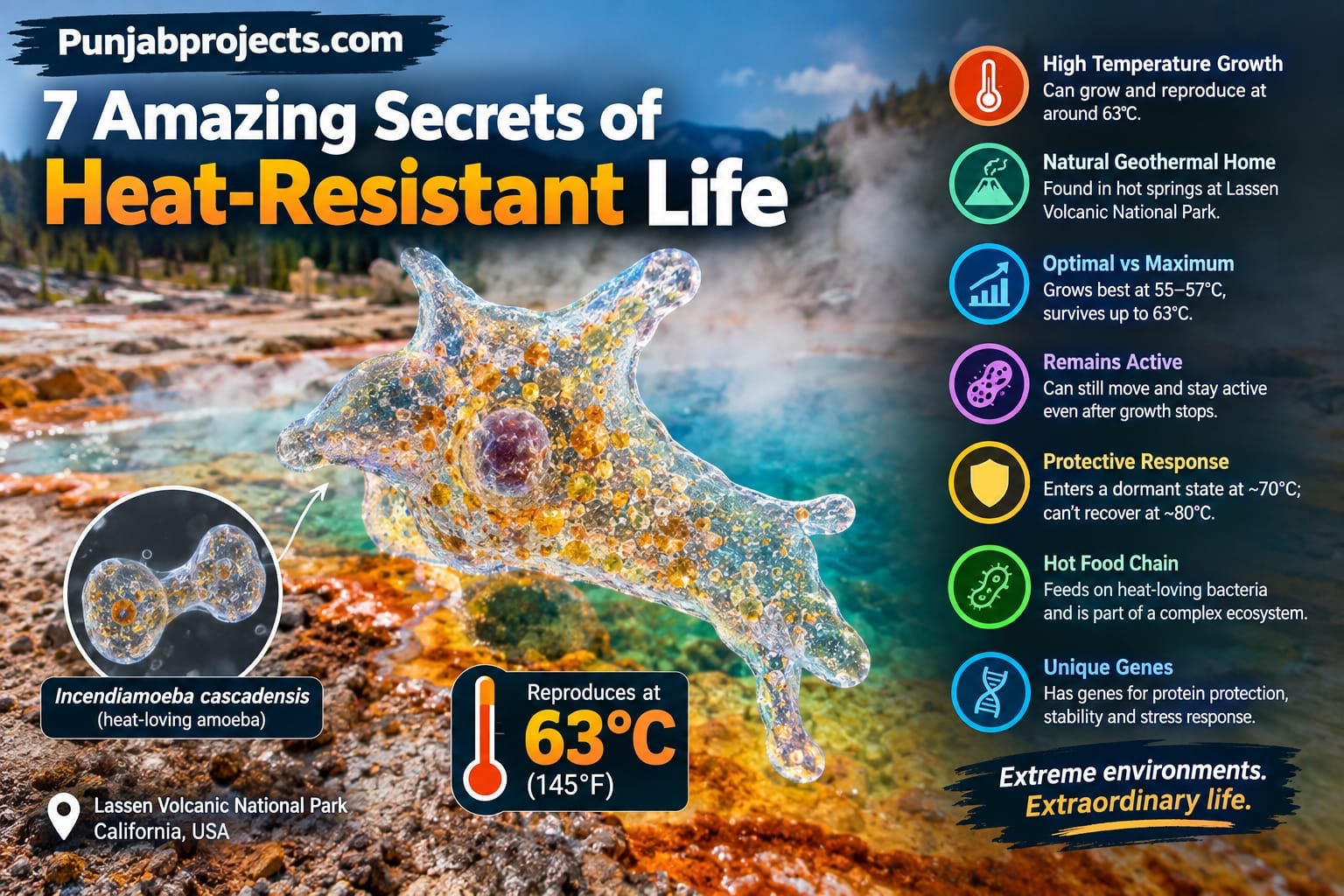
Scientists have identified a new amoeba that can grow and reproduce at temperatures reaching about 63°C (145°F). The organism, named Incendiamoeba cascadensis, was discovered in geothermal waters at Lassen Volcanic National Park in California. The research was published in Cell in September 2026.
This discovery is especially interesting because the organism is a eukaryote. Eukaryotes include animals, plants, fungi, and humans. Until recently, scientists believed that the upper temperature limit for growth among complex eukaryotic life was around 60°C.
The discovery therefore gives researchers a new reason to study Heat-Resistant Life and the biological systems that allow complex cells to function in extreme environments.
1. It Can Grow at Extremely High Temperatures
One of the most remarkable features of this organism is its ability to grow and reproduce at temperatures that would be fatal to most complex organisms.
Laboratory experiments showed that Incendiamoeba cascadensis could continue its life cycle at temperatures close to 63°C. Researchers observed the organism dividing through mitosis under these extreme conditions.
This makes Heat-Resistant Life particularly interesting from a biological perspective. At high temperatures, proteins can lose their structure, membranes can become unstable, and many important cellular reactions can stop working properly.
Yet this amoeba has developed biological systems that allow it to remain functional.
The discovery does not mean that the organism prefers the hottest possible environment. Instead, it shows that its cellular machinery has adapted to tolerate temperatures that are unusually high for complex life.
2. It Was Found in a Natural Geothermal Environment
The organism was not created in a laboratory. It was discovered in a naturally hot environment.
Researchers collected samples from geothermal areas inside Lassen Volcanic National Park. These waters are heated by geological activity beneath the Earth’s surface.
Such environments can contain high temperatures, minerals, gases, and unusual chemical conditions. Therefore, they provide natural laboratories for studying Heat-Resistant Life.
Heat-Resistant Life The researchers collected samples from different locations and examined water, sediment, and biofilm. After isolating the organism, they were able to grow it under controlled laboratory conditions.
This step was important because simply finding an organism near a hot spring does not prove that it can tolerate extreme temperatures.
By growing the amoeba under controlled conditions, scientists could directly test its temperature limits.
3. Its Best Growth Temperature Is Lower Than Its Maximum
An interesting detail is that the amoeba does not grow fastest at its maximum temperature.
Researchers found that its preferred growth range is approximately 55–57°C. Its lower growth limit was around 42°C, while its upper growth limit reached approximately 63°C.
This tells scientists something important about Heat-Resistant Life.
Survival and optimal growth are not the same thing.
Heat-Resistant Life An organism may survive a temperature for a short period without being able to reproduce efficiently at that temperature. The amoeba appears to have a range in which it grows well and another range where it can tolerate stress.
This could be useful in its natural habitat.
Geothermal environments are not always perfectly stable. Temperature can change across very small distances. An organism capable of handling a broad temperature range may be better prepared for these changes.
4. It Can Remain Active Even After Growth Stops
The amoeba has another unusual ability.
At around 64°C, researchers observed that the organism could still remain active even though it could no longer reproduce normally.
This distinction makes Heat-Resistant Life even more fascinating.
Movement requires cellular energy and functioning biological structures. Therefore, remaining active at temperatures above the organism’s reproductive limit suggests that some cellular systems continue operating even under severe heat stress.
The amoeba can also change its shape while moving.
Heat-Resistant Life Researchers observed different cellular forms under different environmental conditions. Such flexibility may help the organism move through its geothermal habitat and search for food.
The ability to remain active for some time under extreme heat could also help the organism move toward a slightly cooler location when conditions become too dangerous.
5. It Has a Protective Response to Extreme Heat
The organism can tolerate temperatures beyond its normal growth range by entering a protective state.
Experiments showed that the amoeba could survive brief exposure to approximately 70°C. At this temperature, it entered a dormant protective condition known as encystment.
Heat-Resistant Life After the temperature was reduced, the cells were able to recover.
This behavior is an important example of how Heat-Resistant Life can respond to sudden environmental stress.
However, the organism is not invincible.
When researchers exposed it to temperatures around 80°C, the cells could not recover in the same way. This demonstrates that even highly adapted organisms have biological limits.
The ability to enter a protective state may therefore be one of the key survival mechanisms that allows this amoeba to live in a constantly changing geothermal environment.
6. It Lives in a Hot Food Chain

Surviving extreme heat would not be enough if the organism could not find food.
The amoeba feeds on bacteria that are themselves capable of living at high temperatures. This creates a small but complex food chain inside the geothermal environment.
The Heat-Resistant Life discovered in this environment therefore exists as part of an ecosystem rather than as an isolated organism.
This is important because extreme environments can sometimes reduce competition.
Heat-Resistant Life Many organisms cannot survive at such high temperatures. As a result, an organism adapted to these conditions may gain access to food sources that are unavailable to less heat-tolerant species.
The geothermal ecosystem demonstrates that even environments that appear hostile can support multiple levels of biological activity.
Scientists are still studying how these organisms interact with each other and how energy moves through these hot ecosystems.
7. Its Genes May Explain Its Extreme Survival Ability
One of the most exciting areas of this research involves genetics.
Scientists assembled the genome of Incendiamoeba cascadensis and identified genes associated with processes that could help the organism handle environmental stress.
These include systems involved in protein protection, genome stability, and sensing changes in the surrounding environment.
Studying these genes could help researchers understand the biological foundation of Heat-Resistant Life.
Proteins are particularly important because extreme temperatures can damage their structure. Organisms living in hot environments therefore need effective ways to protect, repair, or replace damaged proteins.
Heat-Resistant Life If scientists can identify the mechanisms used by this amoeba, those discoveries could eventually become useful in biotechnology.
For example, heat-stable enzymes are already valuable in several industrial processes. However, more research would be required before any practical application could be developed from this particular organism.
Why Is This Discovery Important?
The discovery is important because it changes our understanding of the temperature limits of complex organisms.
For many years, researchers studied extreme environments to determine where life could survive. Simple microorganisms are already known to grow at temperatures far above the limits tolerated by most eukaryotic organisms.
However, complex cells face additional challenges.
Heat-Resistant Life They contain nuclei, internal membranes, and specialized cellular structures. These components can be vulnerable to extreme heat.
The discovery of this amoeba shows that complex life may have more thermal flexibility than previously recognized.
Research into Heat-Resistant Life could therefore reveal new mechanisms of cellular protection and adaptation.
It may also help scientists understand how life evolved in extreme environments on Earth.
Could This Research Help the Search for Life Beyond Earth?
The discovery also has an interesting connection with astrobiology.
Scientists searching for life beyond Earth need to understand what conditions can support biological activity. Organisms on Earth provide natural examples of how life can adapt to extreme environments.
The discovery of Heat-Resistant Life does not prove that life exists on another planet. However, it expands the range of conditions scientists may consider when studying potentially habitable environments.
Heat-Resistant Life Places with geothermal activity can be particularly interesting because heat, water, minerals, and chemical energy can interact there.
Similar environments may have existed on other worlds in the past.
For this reason, extreme organisms on Earth are sometimes used as models for understanding possible extraterrestrial environments.
What Could Scientists Learn From It?
There are still many unanswered questions.
Scientists want to understand exactly how the amoeba’s proteins remain stable at high temperatures. They also want to identify which genes are most important for its survival.
Another question involves its evolutionary history.
Heat-Resistant Life Researchers need to determine how this organism developed such unusual thermal tolerance and whether similar organisms exist in other geothermal locations.
The discovery could lead to additional searches in hot springs around the world.
There may be other organisms with even more unusual adaptations waiting to be identified.
The Future of Extreme-Life Research
The study of Heat-Resistant Life could become increasingly important as scientists explore environments that were previously considered too extreme for complex organisms.
Geothermal regions are only one example.
Heat-Resistant Life Researchers are also investigating deep-sea environments, underground ecosystems, highly acidic locations, frozen habitats, and areas with unusual chemical conditions.
Every new extremophile can provide information about the flexibility of biological systems.
Some of these organisms may contain proteins or cellular mechanisms that could eventually become useful in medicine, biotechnology, environmental science, or industrial research.
However, scientists must first understand how these systems work before their practical value can be determined.
Conclusion
The discovery of Incendiamoeba cascadensis provides a remarkable example of how adaptable life can be.
The organism can reproduce at temperatures close to 63°C, remain active at even higher temperatures, and survive brief exposure to approximately 70°C by entering a protective state.
The study of Heat-Resistant Life could help researchers understand how complex cells protect themselves from extreme thermal stress.
More importantly, the discovery challenges the idea that the limits of complex life are already fully understood.
Heat-Resistant Life As scientists continue exploring Earth’s hottest environments, they may discover additional organisms with surprising survival strategies. Those discoveries could improve our understanding of evolution, biotechnology, and even the possible conditions for life beyond Earth.
Frequently Asked Questions
What is Heat-Resistant Life?
Heat-Resistant Life refers to organisms capable of surviving, remaining active, or reproducing under unusually high temperatures.
What organism inspired this research?
The research focuses on Incendiamoeba cascadensis, an amoeba discovered in geothermal waters at Lassen Volcanic National Park in California.
How hot can the amoeba survive?
The organism can reproduce at approximately 63°C and has been shown to recover after brief exposure to around 70°C.
Can the amoeba survive 80°C?
Laboratory experiments found that exposure around 80°C was too extreme for the tested cells to recover.
Why is this discovery important?
It challenges previous assumptions about the upper temperature limit for complex eukaryotic life and provides scientists with a new organism for studying extreme thermal adaptation.