Microscopic Robot Research: 7 Futuristic Ways Tiny Robots Could Change the World
The future of robotics is becoming smaller, smarter, and more responsive. Researchers are now developing machines that can operate at microscopic scales while sensing and reacting to their surroundings. This new direction in microscopic robot research could eventually influence medicine, agriculture, laboratories, environmental technology, and advanced manufacturing.

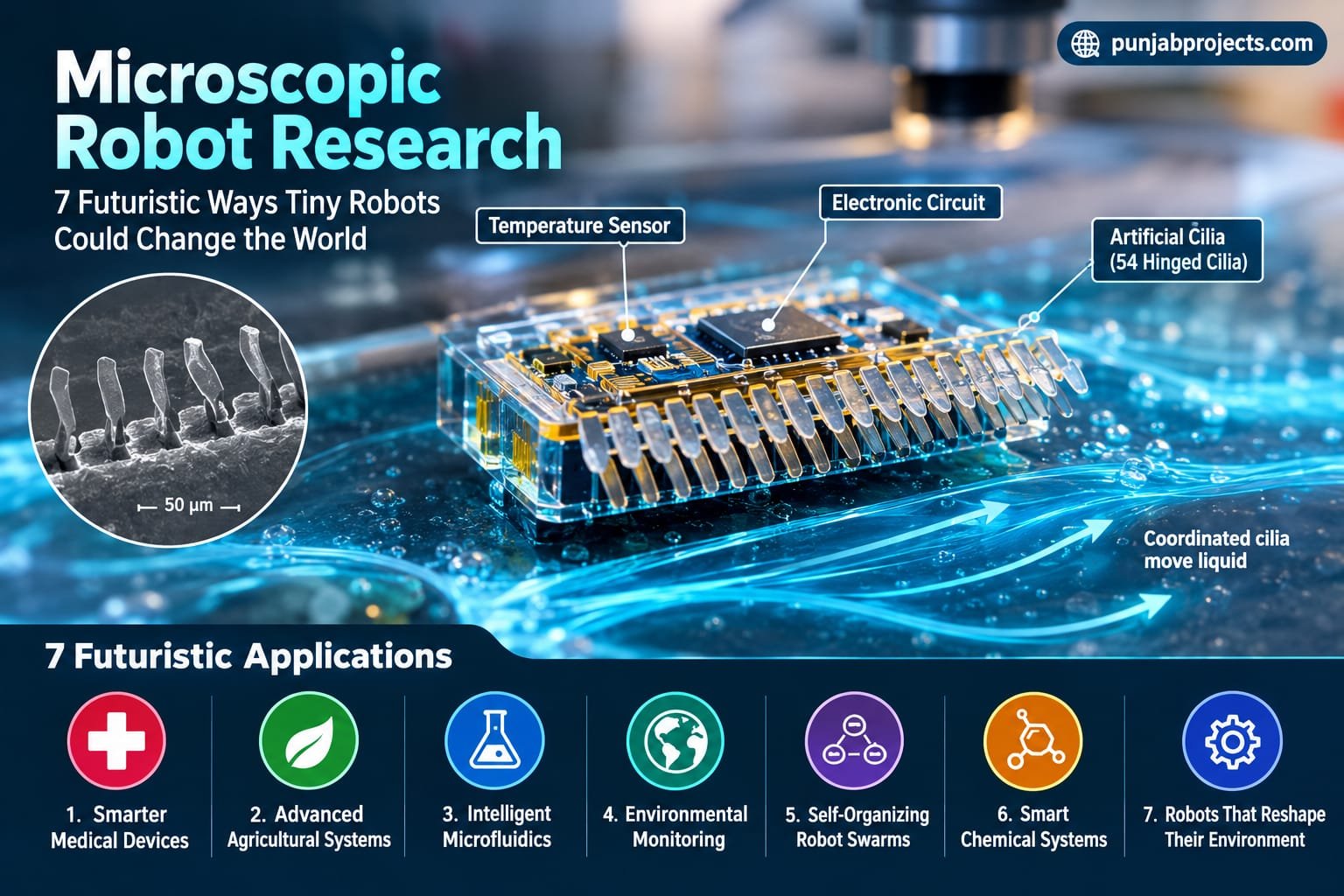
A major development was reported by Cornell University researchers on September 23, 2026. Their latest system combines temperature sensing, electronic communication, and artificial cilia to make microscopic machines respond collectively to their environment. The system can detect temperature changes and coordinate tiny artificial paddles to move liquid.
This development is important because the machines do not simply collect information. They can also produce a physical response.
The latest microscopic robot research shows how tiny machines could eventually become part of intelligent systems that sense their environment and react automatically.
Table of Contents
- What Is Microscopic Robot Research?
- How These Tiny Robots Work
- Temperature-Sensing Microscopic Robots
- Artificial Cilia and Fluid Movement
- 7 Futuristic Applications
- Why Collective Robot Behavior Matters
- Current Challenges
- Future Possibilities
- Frequently Asked Questions
- Conclusion
What Is Microscopic Robot Research?
Microscopic robot research focuses on designing extremely small machines that can sense, move, communicate, and perform specific physical tasks.
Unlike traditional robots, microscopic machines have very limited space for electronics, power systems, sensors, and actuators. Therefore, researchers must combine several functions into extremely small structures.
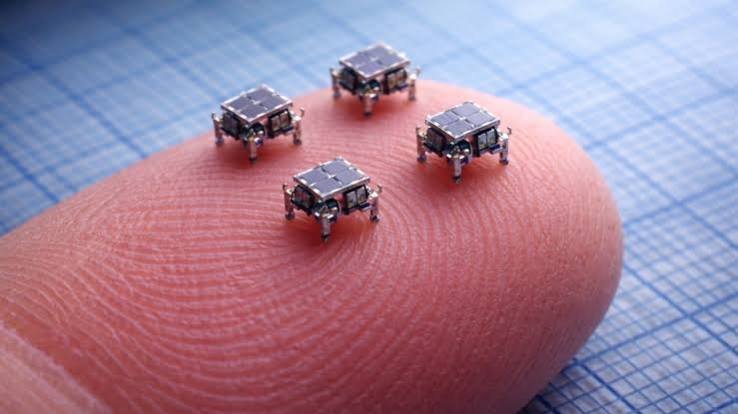
Cornell researchers have been working on microscopic robots that can walk, sense their surroundings, make measurements, create images, and communicate. The latest work adds another capability: coordinated manipulation of the environment.
This makes microscopic robot research especially interesting for the future of intelligent machines.
Instead of creating one large robot with many powerful components, scientists can explore systems made from many tiny components that cooperate.
How These Tiny Robots Work
The new system combines three important functions.
First, the machines can sense temperature. Second, electronic circuits allow different parts of the system to communicate. Third, artificial cilia can move surrounding liquid.
The researchers created an array containing 54 hinged artificial cilia. Temperature-sensing circuits determine how the cilia should operate. One circuit can act as a leader while another follows its signals.
When the temperature changes, the electronic system can change the direction of the cilia movement.
This creates a feedback relationship between the machine and its environment.
That approach represents an important development in microscopic robot research because the environment is no longer simply something the machine moves through. It becomes part of the control system.
Temperature-Sensing Microscopic Robots
Temperature sensing may appear simple, but it becomes much more difficult when the entire system is extremely small.
The Cornell system uses temperature-dependent electronic circuits to control the artificial cilia. When a specific temperature condition is reached, the cilia can change their pumping direction.
The result is a tiny machine that can detect a change and respond without requiring a human operator to manually control every movement.
This concept could become useful in future systems where environmental conditions change continuously.
Future versions of the technology could potentially respond to other signals as well. Researchers have discussed possibilities involving light and pH levels.
Such developments could expand microscopic robot research beyond temperature-based systems.
Artificial Cilia and Fluid Movement
One of the most fascinating parts of this research is the use of artificial cilia.
Natural cilia are tiny hair-like structures found in living organisms. They can help move fluids and particles. Researchers used this biological concept as inspiration for their artificial system.
However, the robotic cilia are not exact copies of biological structures.
The researchers designed a two-hinge architecture. When the hinges move sequentially, they create a paddle-like motion that pushes surrounding liquid.
A single tiny paddle would have only a small effect. Therefore, many cilia must operate together.
The 54-cilia array allows their movements to become coordinated.
This collective behavior is one of the major ideas emerging from modern microscopic robot research.
7 Futuristic Applications of Microscopic Robots
1. Smarter Medical Devices
One possible future application is medicine.
Tiny machines could potentially be designed to operate inside specialized laboratory devices or microfluidic systems. They might sense changes in temperature or chemical conditions and then modify fluid movement.
This could eventually support advanced diagnostic or research equipment.
However, it is important to separate current research from future possibilities. The Cornell system has not been demonstrated as a medical treatment. Medical applications are potential future directions.
Still, the ability to combine sensing and physical action could make microscopic robot research valuable for future biomedical engineering.
2. Advanced Agricultural Systems
Agriculture is another possible area.
Future microscopic machines could potentially monitor environmental conditions such as temperature, moisture, acidity, or chemical concentrations.
Instead of simply reporting measurements, a future system might respond automatically.
For example, tiny machines could potentially help regulate conditions inside controlled agricultural environments or laboratory-grown systems.
Cornell researchers have specifically mentioned agriculture as a possible future application for more advanced versions of the technology.
This shows how microscopic robot research could eventually connect robotics with environmental control.
3. Intelligent Microfluidics
Microfluidics involves controlling very small amounts of liquid.
These systems are already important in scientific laboratories and biological research. However, many microfluidic systems operate according to fixed designs.
Microscopic robots could potentially make them more adaptive.
A future device could sense temperature or chemical changes and adjust liquid movement automatically.
Instead of following one fixed sequence, the system could respond to changing conditions.
This is one reason microscopic robot research could become important for next-generation laboratory technology.
4. Environmental Monitoring
Environmental monitoring could also benefit from tiny responsive machines.
Future systems might detect changes in local conditions and react to those changes.
For example, a microscopic robotic network could potentially detect a chemical or temperature difference and modify local fluid movement.
The current Cornell experiment does not demonstrate environmental cleanup. Instead, it provides an early example of machines sensing and physically influencing their environment.
As microscopic robot research develops, researchers may explore more advanced environmental applications.
5. Self-Organizing Robot Swarms
Another futuristic possibility is robotic swarms.
Instead of controlling every robot from a central computer, researchers could design machines that communicate locally.
Each robot would follow relatively simple rules. However, when many robots interact, a much more complex collective behavior could emerge.
The Cornell system already demonstrates synchronized movement between microscopic components.
This principle could eventually help researchers build larger groups of tiny machines.
In advanced microscopic robot research, collective behavior may become as important as the capabilities of individual robots.
6. Smart Chemical Systems
Chemical laboratories often require precise control of fluids, temperatures, and concentrations.
Future microscopic robots could potentially help automate some of these processes.
A responsive robotic system might detect a change in its surroundings and modify fluid movement accordingly.
Researchers have also discussed future systems that respond to signals such as pH or light.
Such systems could potentially trigger mechanical or chemical actions under specific conditions.
This could create a new generation of adaptive laboratory equipment.
7. Robots That Reshape Their Environment
Perhaps the most futuristic possibility is the development of robots that can actively reshape their surroundings.
The latest Cornell research represents an early demonstration of this idea.
The system can sense temperature and use synchronized artificial cilia to move liquid. That means the robots can detect a condition and then produce a physical effect that changes the environment.
This feedback loop is particularly important.
In future microscopic robot research, scientists could attempt to create machines that respond to several environmental signals at once.
A tiny robot might eventually sense temperature, light, chemicals, or pressure and then choose a corresponding mechanical response.
Why Collective Robot Behavior Matters
A major lesson from this research is that individual robots do not always need to be extremely powerful.
Instead, many simple machines can work together.
Nature provides many examples of this concept. Ants, termites, insects, and microorganisms can create large-scale effects through local interactions.
Researchers are attempting to apply similar principles to robotics.
The Cornell system uses electronic signals to synchronize the movement of its artificial cilia. The researchers compared this synchronization approach with patterns found in nature, including the coordinated flashing of fireflies.
This concept could become extremely important for future microscopic robot research.
If thousands of tiny machines can communicate and coordinate effectively, their combined effect could be much greater than the capabilities of one machine.
Current Challenges
Despite the exciting possibilities, microscopic robotics still faces major technical challenges.
The first challenge is power.
Tiny machines have very little space for batteries. Therefore, researchers must develop extremely efficient ways to provide energy.
The second challenge is communication.
Coordinating microscopic machines requires reliable communication systems. Even a small delay or error could affect collective behavior.
The third challenge is manufacturing.
Producing thousands or millions of highly precise microscopic machines can be difficult and expensive.
Safety is another important issue, particularly if future systems are designed for medical or biological environments.
Therefore, microscopic robot research is still developing. Many potential applications remain experimental rather than commercially available technologies.
Future Possibilities
The future could bring microscopic machines with much more advanced sensing capabilities.
Instead of responding only to temperature, future robots could potentially react to light, acidity, chemical concentrations, pressure, or other environmental signals.
Researchers could also move from fixed arrays toward independently moving microscopic robots.
Such machines could potentially travel through specialized environments while communicating with nearby robots.
The ultimate goal could be a system where many tiny machines cooperate without requiring constant external control.
This could create a new type of robotics in which intelligence emerges from interactions between machines and their environment.
That possibility makes microscopic robot research one of the more fascinating areas of future engineering.
Frequently Asked Questions
What is microscopic robot research?
Microscopic robot research is the study and development of extremely small machines that can sense, move, communicate, or perform physical tasks.
What did Cornell researchers demonstrate?
Cornell researchers demonstrated microscopic robots that can sense temperature and coordinate artificial cilia to move liquid in response to environmental conditions.
How many artificial cilia were used?
The reported experimental system used an array of 54 hinged artificial cilia.
Can these robots currently be used inside humans?
The reported research does not demonstrate a medical treatment or robots operating inside humans. Medical applications are potential future directions.
Why are artificial cilia useful?
Artificial cilia can create controlled movement in surrounding liquid. When many cilia operate together, their combined motion can produce a larger fluid movement.
Could these robots respond to chemicals?
Future versions may potentially respond to signals such as pH or other environmental cues. These capabilities are areas for further research rather than demonstrated applications of the current system.
Why is synchronization important?
Synchronization allows many microscopic components to operate together. This can create collective effects that would not be possible with a single tiny actuator.
Conclusion
The latest microscopic robot research shows how robotics is moving toward a fascinating new direction.
Researchers are no longer focusing only on making machines smaller. They are also trying to make tiny machines capable of sensing their environment, communicating with one another, and producing coordinated physical effects.
The Cornell system demonstrates this idea through temperature sensing and synchronized artificial cilia that move liquid.
The technology is still at an early research stage. However, its basic concept could inspire future medical devices, agricultural technologies, microfluidic systems, environmental tools, and intelligent robotic swarms.
The most important idea may be collective behavior.
A single microscopic machine may have very limited power. But hundreds or thousands of coordinated machines could potentially produce meaningful effects.
As microscopic robot research continues, future robots may become smaller while their collective capabilities become much larger.