AI Research Gaps: 7 Powerful Solutions to Hidden Science Problems
AI Research Gaps are becoming an important part of modern scientific research because researchers now have access to millions of papers, datasets, experiments, and scientific records. Finding what is already known can be difficult, but discovering what is still missing can be even harder. Artificial intelligence can help researchers analyze large amounts of information, compare existing knowledge, detect patterns, and identify areas that may need further investigation. However, AI does not replace scientists; instead, it can provide useful clues that researchers can verify through proper scientific methods.
Table of Contents
- What Are AI Research Gaps?
- Why AI Research Gaps Matter
- 7 Powerful Solutions Using AI Research Gaps
- Finding Missing Knowledge
- Connecting Different Research Fields
- Detecting Weak or Limited Evidence
- Predicting Emerging Research Areas
- Benefits and Challenges
- Simple Research Gap Workflow
- Frequently Asked Questions
- Conclusion
What Are AI Research Gaps?
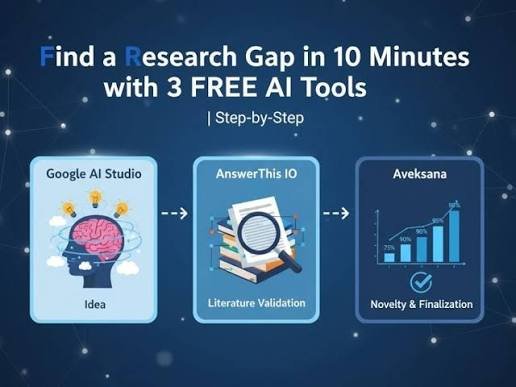
AI Research Gaps refer to missing, limited, unclear, or underexplored areas that artificial intelligence can help researchers identify within scientific knowledge. A research gap does not always mean that nobody has studied a topic. Sometimes it means that the available evidence is too limited, different studies disagree, a particular population has not been studied enough, or a connection between two research areas has not been explored.
Traditional research-gap analysis can require researchers to read a large number of papers manually. AI can make this process faster by examining large collections of scientific literature and identifying relationships that might be difficult to notice during a normal literature review.
The final decision, however, should remain with qualified researchers. AI-generated suggestions need to be checked against original studies, reliable datasets, and appropriate research methods.
Why AI Research Gaps Matter
Modern science is expanding rapidly. Every research field produces new papers, datasets, experiments, and theories. Because of this growth, researchers can sometimes struggle to understand the complete picture.
AI Research Gaps can help organize this information. An AI system can compare keywords, concepts, citations, study results, and research trends to highlight areas that deserve additional attention.
For example, suppose hundreds of studies examine two scientific concepts separately but very few investigate their relationship. AI could potentially detect this separation and suggest that the connection deserves further research.
This creates an opportunity for researchers to move beyond simply asking, “What has already been studied?” They can also ask, “What important questions remain unanswered?”
7 Powerful Solutions Using AI Research Gaps
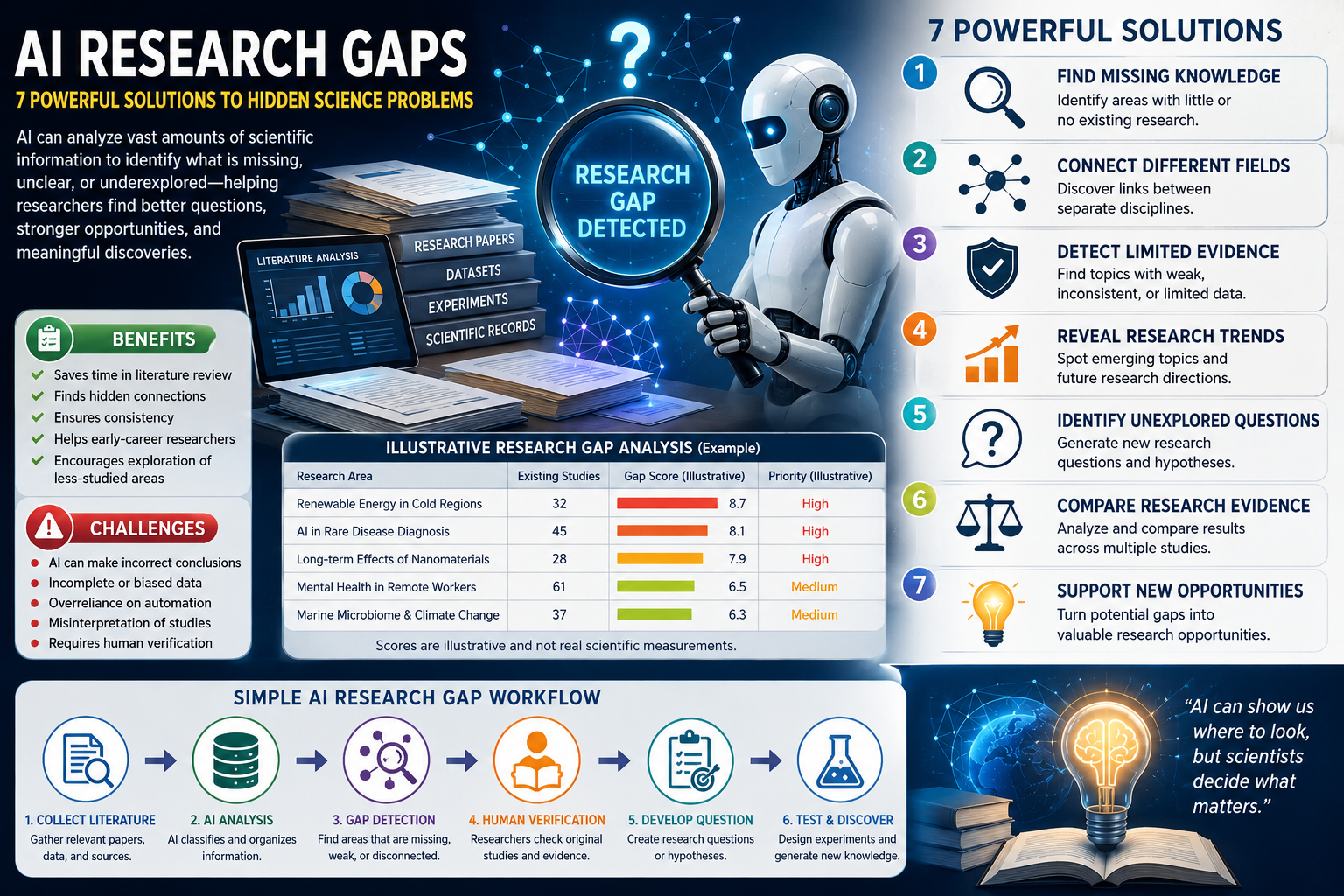
1. AI Research Gaps Can Find Missing Knowledge
One of the most useful applications is identifying areas where scientific knowledge remains incomplete.
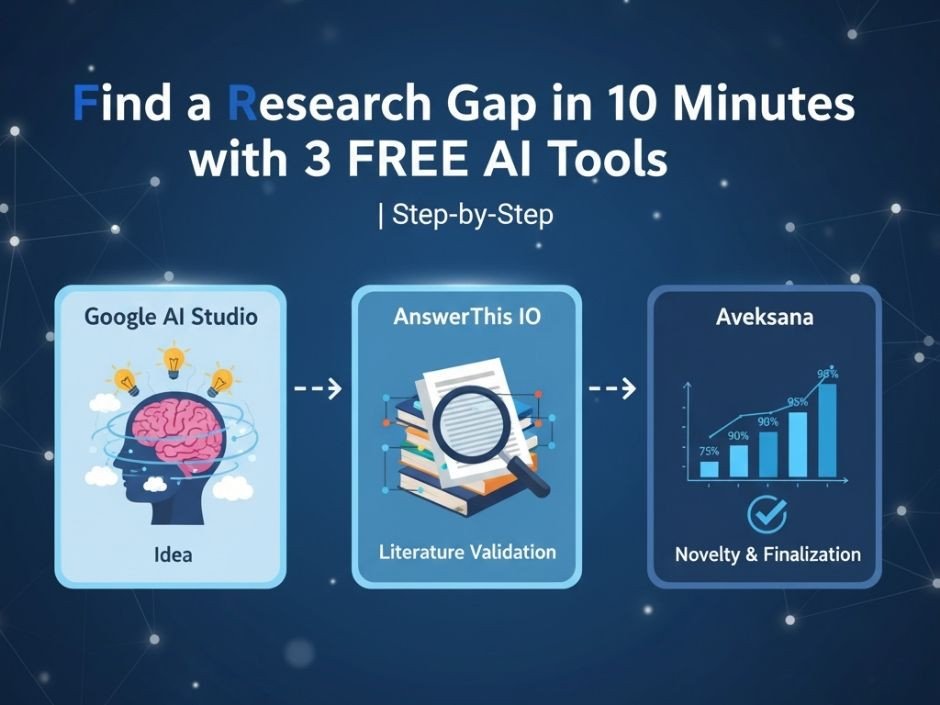
AI systems can process large collections of papers and categorize them according to topics, methods, results, and research questions. When an area receives substantial attention while a closely related area receives very little, the difference can become a useful signal.
For instance, researchers studying environmental technology may find hundreds of papers about one type of renewable system but significantly fewer studies about its performance under particular environmental conditions.
This does not automatically prove that a research gap exists. Instead, it gives scientists a starting point for investigating the literature more carefully.
2. AI Research Gaps Can Connect Different Fields
Some of the most interesting discoveries happen when researchers combine knowledge from different scientific disciplines.
AI can analyze terminology and concepts from multiple fields and identify potential connections. A medical researcher, for example, might benefit from research in computer science, materials science, statistics, or engineering.
These connections can be difficult to discover manually because different disciplines often use different terminology.
AI can act as a bridge between these knowledge areas by mapping related concepts and showing where research communities may be working separately.
3. AI Research Gaps Can Detect Limited Evidence
Not every research topic has strong evidence behind it. Some subjects may have many studies but only a small number of high-quality experiments.

AI can help researchers organize studies according to factors such as methodology, sample characteristics, research design, and reported findings. This can help reveal areas where evidence may be limited or inconsistent.
For example, if many studies reach different conclusions about a scientific question, that disagreement itself may become an important research opportunity.
Researchers can then investigate why the results differ and design better experiments to address the uncertainty.
4. AI Research Gaps Can Reveal Research Trends
Scientific fields do not remain static. Some research topics grow rapidly while others become less active.
AI can examine publication patterns, keywords, citations, and related concepts to identify emerging research directions.
This makes AI Research Gaps particularly useful for researchers who want to understand where a field may be heading.
An emerging topic with relatively little existing research can represent an opportunity for early investigation. At the same time, researchers should avoid assuming that every new trend will become scientifically important.
5. AI Research Gaps Can Identify Unexplored Questions
Researchers often start with a broad question and gradually narrow it into a testable hypothesis.
AI can help generate possible research questions by comparing existing findings and identifying areas that have received limited attention.
For example, a literature-analysis system might notice that researchers have studied a technology extensively in laboratory conditions but rarely examined its long-term performance in real-world environments.
That difference can lead to a more specific research question.
The important point is that AI should generate possibilities rather than automatically declare them scientific facts.
6. AI Research Gaps Can Compare Research Evidence
Another powerful use is comparing evidence across multiple studies.
Different researchers may use different datasets, methods, populations, or experimental conditions. AI can organize these differences and help researchers see why results may not agree.
This can make literature reviews more systematic and help researchers identify areas where additional evidence is needed.
However, AI-generated comparisons must be checked carefully. A computer system may misunderstand scientific terminology, overlook methodological details, or incorrectly connect studies that appear similar but actually investigate different questions.
7. AI Research Gaps Can Support New Research Opportunities
Once a possible research gap has been identified, researchers can evaluate whether it is worth investigating.
A useful research opportunity should normally have a clear question, available methods or data, scientific relevance, and a realistic way to test the proposed idea.
AI can help organize these factors and provide researchers with a starting framework.
This is one of the strongest advantages of AI Research Gaps: instead of searching randomly for an original topic, researchers can use evidence from existing literature to identify areas where additional work may be valuable.
AI Research Gaps and the Research Process
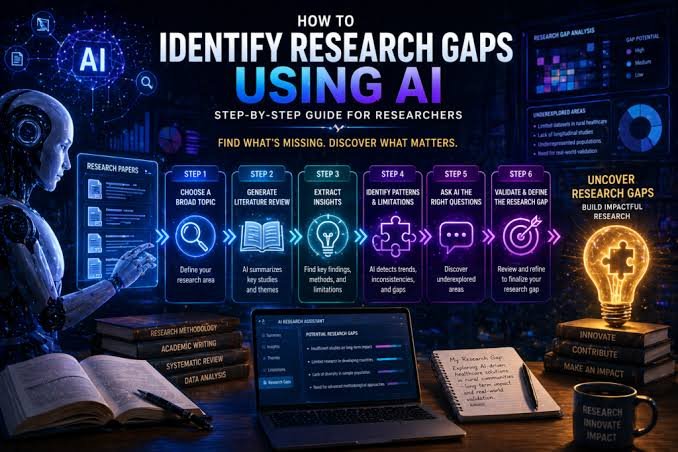
A simple AI-supported research-gap process can begin with collecting relevant scientific literature. Researchers can then use AI to classify papers by topic, method, dataset, and findings.
The next stage is comparison. The system looks for areas that appear heavily researched, lightly researched, disconnected, or inconsistent.
After that, researchers manually examine the most promising findings. They return to the original papers and check whether the suggested gap is actually valid.
Finally, researchers can develop a research question or hypothesis and determine how it can be tested.
This process shows an important principle: AI Research Gaps are a research-support tool, not a replacement for scientific judgment.
Illustrative Research-Gap Analysis
The following chart uses illustrative scores, not measured scientific data. It simply demonstrates how researchers might rank potential research gaps after an AI-assisted literature analysis.
The purpose of such a ranking is not to prove that one research area is objectively more important than another. Instead, it can help researchers decide which questions deserve closer human investigation.
Benefits of AI Research Gaps
AI Research Gaps can provide several practical benefits. First, they can reduce the amount of time researchers spend manually organizing large literature collections. Second, AI can identify relationships between concepts that may not be obvious from individual papers.
Another benefit is consistency. A properly designed system can apply the same search and classification rules across a large collection of documents.
AI can also help early-stage researchers understand complex fields more quickly. Students and new researchers may use AI-assisted tools to discover important terminology, related studies, and possible unanswered questions.
Most importantly, AI can encourage researchers to look beyond popular topics and investigate less-explored areas.
Challenges of AI Research Gaps
Despite these advantages, AI Research Gaps also have limitations.
AI systems can produce incorrect conclusions. A research paper may be poorly understood because of technical language, unusual terminology, or limitations in the underlying model.
Another problem is incomplete literature. If important studies are missing from the dataset or search system, AI may incorrectly identify an area as a research gap.
Bias is another concern. Research databases may contain more studies from some countries, institutions, languages, or disciplines than others. An AI system trained on an incomplete collection can therefore produce an incomplete picture.
There is also a risk of overreliance on automation. Researchers should never treat an AI-generated research gap as proof that a topic is original.
Human researchers still need to read important papers, verify evidence, evaluate methodology, and determine whether a proposed research question is genuinely useful.
How to Use AI Research Gaps Responsibly
Researchers can make the process more reliable by using AI as an assistant rather than an authority.
Start with a clearly defined research field. Then collect high-quality and relevant sources. Use AI to organize the literature and identify possible patterns.
After that, verify every important claim by returning to the original research papers.
It is also useful to search for alternative explanations. If AI says that an area is poorly researched, researchers should check whether the apparent gap is actually caused by different terminology, indexing problems, or a lack of accessible publications.
This extra verification step can prevent false conclusions.
AI Research Gaps and the Future of Science
The future of AI Research Gaps could become even more advanced as AI systems improve their ability to understand scientific language, datasets, figures, references, and relationships between disciplines.
Future research platforms may be able to create detailed maps of scientific knowledge and highlight areas where evidence is weak or connections remain unexplored.
AI could also make cross-disciplinary research easier. A researcher working in one field may discover useful concepts from another field without needing to manually search through unrelated databases.
However, scientific discovery will still depend on experimentation, critical thinking, evidence, and human creativity. AI can suggest where researchers should look, but scientists must determine whether the suggested direction is meaningful.
Frequently Asked Questions
What are AI Research Gaps?
AI Research Gaps are missing, limited, unclear, or underexplored areas of scientific knowledge that AI can help researchers identify by analyzing literature, data, and relationships between studies.
Can AI find a completely new research topic?
AI can suggest potentially underexplored topics, but researchers must verify the literature before claiming that a topic is genuinely new.
Is AI reliable for finding research gaps?
AI can be useful for discovering patterns in large amounts of information, but it can also make mistakes. Human verification is essential.
Can students use AI to find research gaps?
Yes. Students can use AI-assisted literature analysis to organize papers, discover related concepts, and develop possible research questions. They should still verify information using reliable academic sources.
Does AI replace researchers?
No. AI can support literature analysis and idea generation, but scientific judgment, experimentation, interpretation, and validation still require researchers.
What is the biggest benefit of AI Research Gaps?
One major benefit is the ability to process large amounts of research information and highlight possible areas that deserve deeper investigation.
Conclusion
AI Research Gaps offer a powerful way to explore what science may still be missing. By analyzing scientific literature, comparing evidence, connecting different disciplines, identifying conflicting findings, and spotting emerging topics, AI can help researchers find promising directions faster.
However, AI should not be treated as the final authority. A suggested research gap must be checked against original studies and evaluated by researchers who understand the scientific field.
The strongest approach combines artificial intelligence with human curiosity, critical thinking, and rigorous scientific methods. When used responsibly, AI Research Gaps can help researchers move from a huge collection of existing knowledge toward better questions, stronger research opportunities, and potentially important scientific discoveries.