Brain Goal Blending: New 2026 Research Reveals How It Works
Have you ever tried to focus on two things at the same time? Perhaps you were walking toward a destination while avoiding obstacles, or trying to reach one target while keeping another objective in mind. Your behaviour can change from one moment to the next as the situation develops. But how does the brain manage these changing demands?
New research published in Nature in August 2026 offers an interesting answer. Scientists have found evidence that the brain can combine different goal-related strategies instead of simply switching completely from one objective to another.
This process, known as brain goal blending, provides a new way to understand how people behave when several objectives are relevant at the same time. The study, titled “Neural basis of compositional control,” examined how humans adjust their behaviour during continuously changing situations.
The findings suggest that the brain does not always have to choose one goal and ignore another. Instead, different strategies can be combined and adjusted depending on what is happening.
What Is Brain Goal Blending?
The idea becomes easier to understand through a simple example.
Imagine that you are following a moving target. Your main objective may be to get closer to it. However, the situation can suddenly change. Another target may become more important, or an obstacle may force you to change direction.
Brain Goal Blending In such circumstances, the brain does not necessarily need to completely abandon one strategy before using another.
Instead, different goal-related strategies can be combined. Their influence can then be increased or reduced depending on the current situation. This flexible process is what researchers describe through the idea of goal blending.
Importantly, this does not mean that the brain is performing two completely unrelated tasks at exactly the same time. Rather, several strategies may contribute to the same continuous behaviour, while their relative importance is adjusted over time.
How Was the Research Conducted?
To investigate this process, participants were asked to perform a continuous prey-pursuit task. Their movements and decisions provided researchers with a way to study how behaviour changes while different objectives are relevant.
A mathematical approach based on control theory was then used to analyze the participants’ behaviour.
Brain Goal Blending Through this approach, different goal-specific control policies could be identified, and their changing influence could be estimated throughout the task.
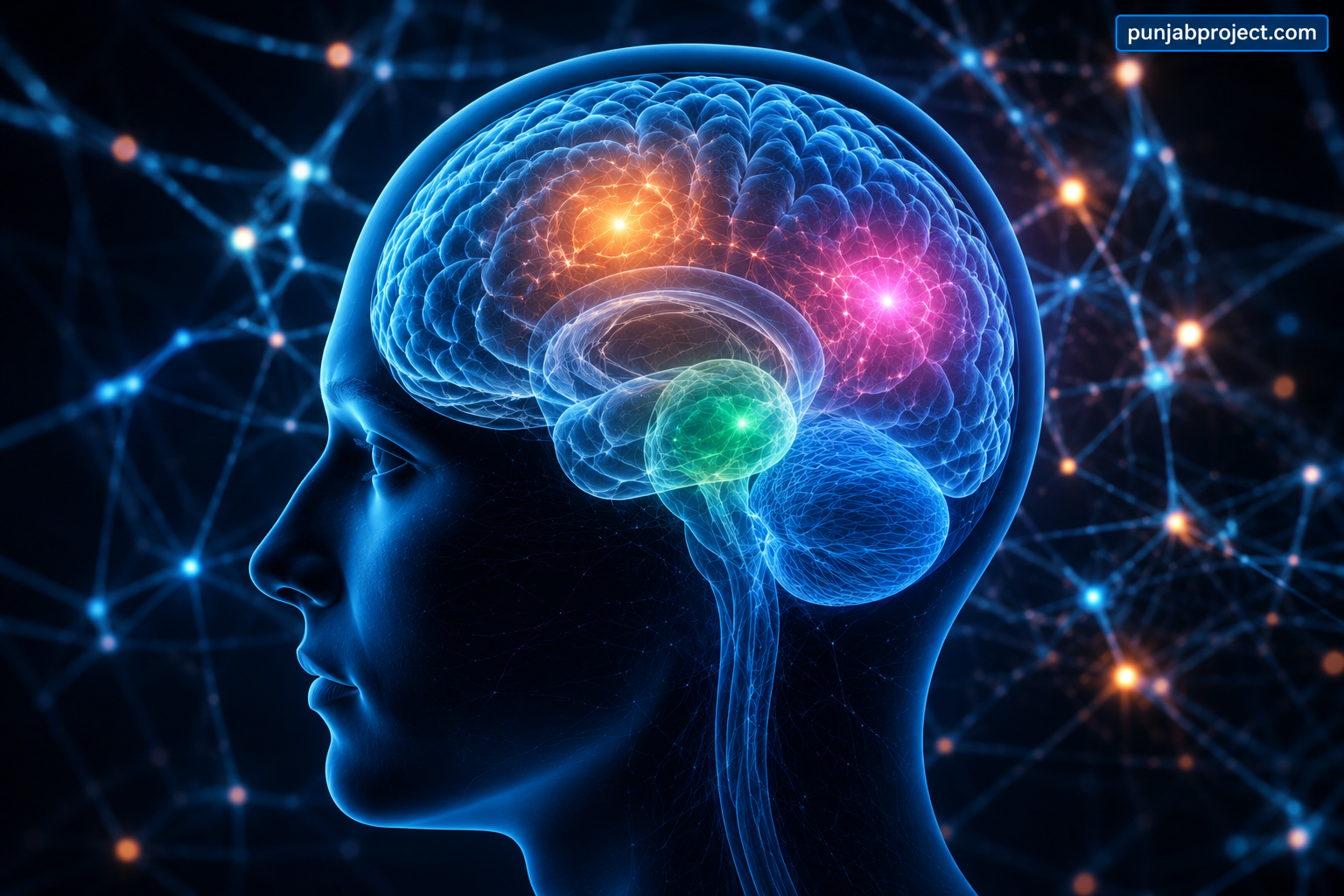
Brain activity was also examined. Particular attention was given to three regions: the hippocampus, anterior cingulate cortex (ACC), and orbitofrontal cortex (OFC).
Brain Goal Blending Different patterns of activity were identified in these regions, suggesting that each contributes to a different part of the goal-management process.
How Does the Brain Combine Different Strategies?
One of the most interesting aspects of the research is that behaviour was not treated as a simple sequence of separate decisions.
Brain Goal Blending Instead, the researchers proposed that lower-level strategies can be combined under the control of a higher-level system.
In other words, several strategies may be available at the same time. The brain can then adjust how strongly each strategy influences behaviour.
This provides a useful explanation for why human behaviour can remain flexible when priorities change.
For example, imagine that you are trying to reach a destination quickly but suddenly notice something dangerous in your path. Your original goal has not disappeared. However, avoiding the danger becomes more important for your immediate behaviour.
As a result, the balance between different strategies changes.
The Role of the Hippocampus
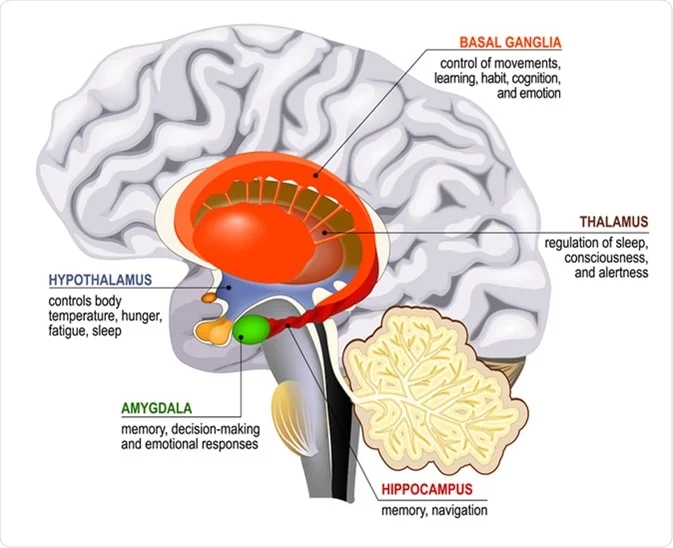
The hippocampus is widely known for its role in memory and spatial navigation. However, the new research suggests that it may also contribute to continuous goal-directed behaviour.
The researchers found that hippocampal neurons encoded and updated information related to a latent policy state. Put simply, activity in this region appeared to help the brain estimate the current underlying state of the task.
This information can be particularly important when circumstances are changing.
Brain Goal Blending Before deciding what to do next, the brain needs some understanding of what is currently happening. If that internal state changes, the information being used for planning also needs to be updated.
Therefore, the hippocampus may help maintain an ongoing representation of the situation while different strategies are being considered.
How the Anterior Cingulate Cortex Helps
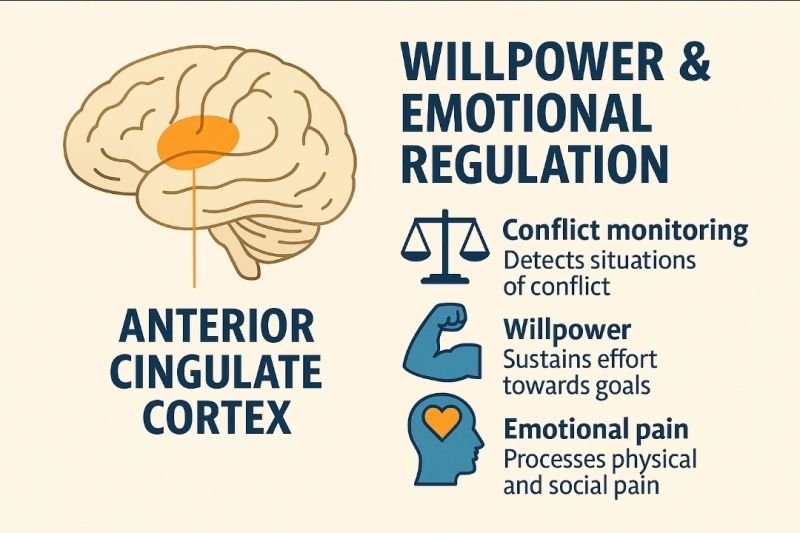
Another important finding involved the anterior cingulate cortex, commonly known as the ACC.
Researchers found that activity in this region could predict major changes in the mixture of goal-related policies. This suggests that the ACC has an important role in coordinating changes in strategy.
This becomes especially useful when priorities shift.
For instance, a person may initially focus strongly on one objective. Then, new information may make another objective more important. The brain needs to adjust its behaviour accordingly.
The ACC may help coordinate this change rather than simply controlling one specific movement or decision.
In this sense, it can be viewed as part of a higher-level control system that helps determine how different strategies should be balanced.
What Does the Orbitofrontal Cortex Do?
The orbitofrontal cortex (OFC) showed a somewhat different pattern.
According to the study, OFC activity was more consistent with representing the current value structure of the task than directly controlling changes in policy.
This distinction matters because the value of an outcome can change depending on the situation.
Something that is important in one moment may become less important later. The brain therefore needs information about the current context and the relative value of possible outcomes.
Brain Goal Blending The OFC appears to contribute to this part of the process.
Consequently, information from the OFC can be considered alongside state-related information from the hippocampus and strategy-related information associated with the ACC.
Is Goal Blending the Same as Multitasking?
It would be easy to describe these findings as proof that the brain can multitask. However, that would be an oversimplification.
The study is more specifically about continuous goal-directed behaviour and the blending of different control strategies.
When several goals are relevant, the brain may not simply switch from Goal A to Goal B. Instead, different strategies can be combined, with their relative influence changing over time.
This distinction is important.
For example, driving involves many objectives. A driver wants to reach a destination, maintain a safe speed, avoid other vehicles, respond to traffic signals, and remain aware of the surrounding environment.
These objectives interact continuously. Therefore, the brain has to adjust behaviour rather than make one decision and stop reconsidering it.
Why Is This Research Important?
The findings provide a new way of thinking about how humans make decisions in changing environments.
Many traditional decision-making models focus on discrete choices. A person chooses one option and rejects another. However, real-world behaviour is often much more fluid.
Walking, navigating, driving, playing sports, and interacting with other people all require constant adjustments.
Brain Goal Blending The control-theory framework used in this research provides a way to study these continuous adjustments mathematically.
Moreover, it connects ideas from neuroscience with methods traditionally used to understand complex control systems.
This could help researchers develop more detailed models of how humans behave when several objectives are relevant at the same time.
Could These Findings Influence Artificial Intelligence?
The research may also have implications for artificial intelligence and robotics.
Modern autonomous systems often have multiple objectives. A robot, for example, may need to reach a destination while avoiding obstacles and conserving energy.
If an artificial system simply switches completely between different objectives, its behaviour may become inefficient.
The brain’s apparent ability to combine different strategies could therefore provide inspiration for future computational models.
However, the study itself does not introduce a new AI system. Instead, it provides a biological framework that could potentially be explored in future AI and robotics research.
What Do We Still Need to Learn?
Although the findings are important, they do not provide a complete explanation of human decision-making Brain Goal Blending.
The experiment focused on a particular continuous prey-pursuit task. Therefore, additional research will be needed to determine whether the same mechanisms operate across many other forms of behaviour.
It would be especially interesting to investigate how goal blending works in situations involving social decisions, long-term planning, financial choices, or complex problem-solving.
Brain Goal Blending Likewise, future studies may examine how these brain regions interact with other neural systems.
So, while the findings provide an important piece of the puzzle, much more remains to be discovered Brain Goal Blending.
A New Perspective on Human Behaviour
The research changes the way we can think about some everyday actions.
A simple movement may appear straightforward from the outside. Yet several objectives can be influencing that movement at the same time.
The brain may constantly evaluate the current situation, consider different strategies, and adjust their relative influence Brain Goal Blending.
This helps explain why human behaviour can be so flexible.
Rather than operating through a rigid sequence of instructions, the brain appears to have mechanisms that allow strategies to be combined and modified as circumstances change.
That flexibility is especially valuable in unpredictable environments, where priorities can shift within seconds Brain Goal Blending.
Conclusion
The new 2026 research provides valuable insight into brain goal blending and the way humans manage multiple objectives.
Rather than simply switching between completely separate goals, the brain appears capable of combining different goal-related strategies and adjusting their influence according to the situation.
The hippocampus, anterior cingulate cortex, and orbitofrontal cortex appear to make different contributions to this process. Together, they may help the brain understand its current state, coordinate changes in strategy, and account for the value and context of different outcomes Brain Goal Blending
Ultimately, the research suggests that managing multiple goals is more sophisticated than simply multitasking. It may depend on a continuous process in which the brain blends and rebalances strategies as circumstances change.
Frequently Asked Questions
What is brain goal blending?
Brain goal blending refers to the process of combining different goal-related strategies and adjusting their relative influence as circumstances change.
How does goal blending work?
Different strategies can contribute to behaviour at the same time. Their influence can then be increased or reduced depending on the person’s current situation and objectives.
Which brain regions are involved in goal blending?
The study identified important roles for the hippocampus, anterior cingulate cortex, and orbitofrontal cortex. Each region appears to contribute differently to the overall process.
How was the research conducted?
Participants performed a continuous prey-pursuit task. Their behaviour was analyzed using a control-theoretic model, while neural activity in several brain regions was examined.
Is goal blending the same as multitasking?
No. The findings are more specifically related to combining and adjusting goal-directed strategies during continuous behaviour. They do not prove that humans can perform two unrelated tasks simultaneously without limitations.
When was the research published?
The original research paper, “Neural basis of compositional control,” was published in Nature on August 12, 2026.