AI Research Discovery Maps: 7 Powerful Ways AI Predicts the Future of Science
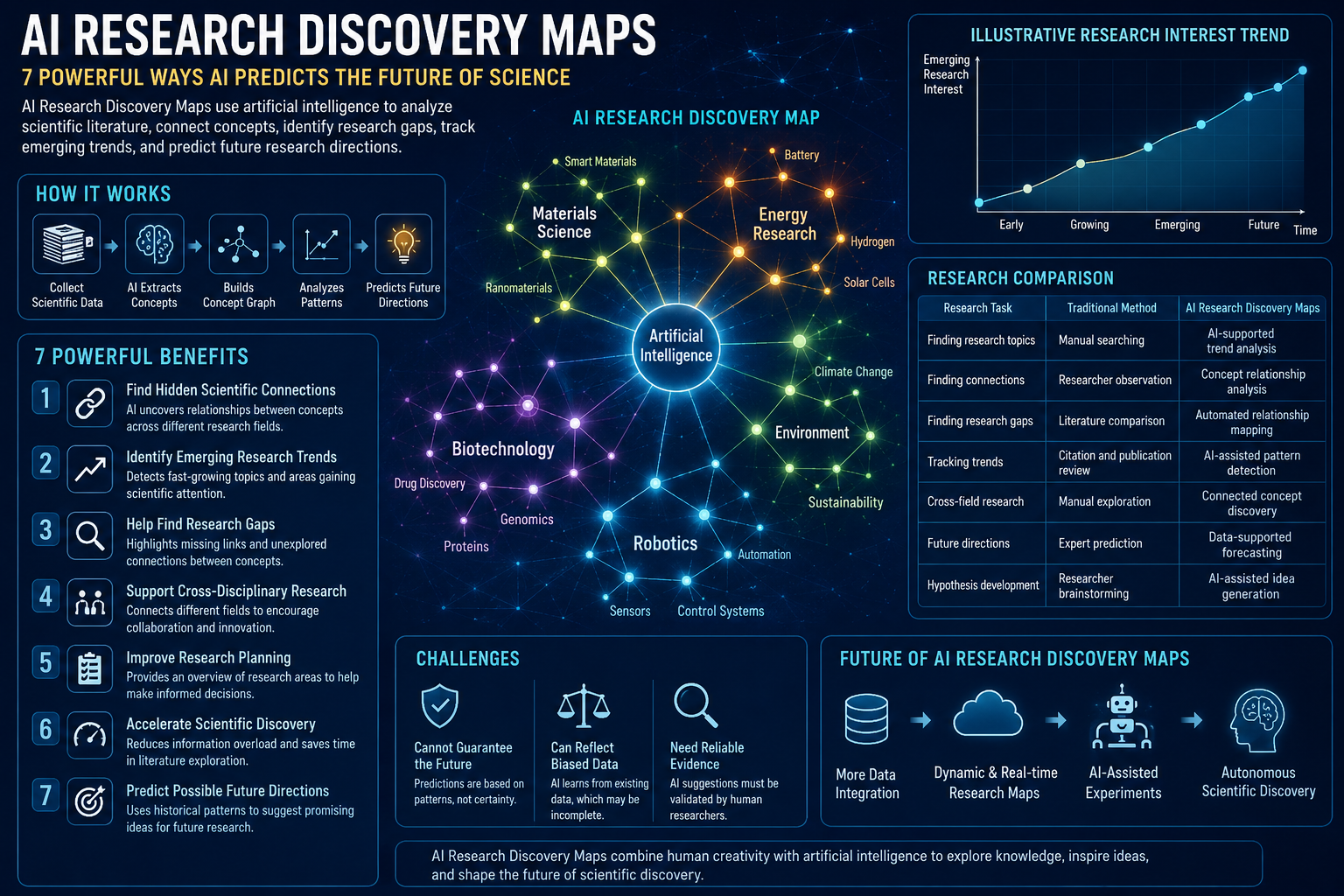
Science is producing new studies, datasets, and discoveries at an incredible speed. AI Research Discovery Maps offer a powerful way to organize this growing body of knowledge and identify where scientific research may be heading next. By analyzing research papers, concepts, relationships, and historical trends, artificial intelligence can help researchers discover connections that may be difficult to notice manually. Recent research has explored large language models and concept graphs for identifying emerging combinations of scientific ideas and predicting possible future research directions.
Table of Contents
- What Are AI Research Discovery Maps?
- How AI Research Discovery Maps Work
- 7 Powerful Benefits
- Challenges
- Future of AI Research Discovery Maps
- Conclusion
- FAQs
What Are AI Research Discovery Maps?

AI Research Discovery Maps are AI-supported visual or computational systems that organize scientific concepts and show relationships between research topics. Instead of looking at individual papers separately, these systems can connect ideas across thousands of publications.
For example, research about batteries may contain concepts involving lithium, solid-state materials, energy storage, electric vehicles, and artificial intelligence. An AI system can analyze these concepts and identify relationships between them.
The result can be viewed as a research map showing established areas, growing topics, and possible connections that deserve additional investigation.
These maps do not actually know the future. Instead, they use information from existing research to identify patterns that may indicate where scientific attention could move next.
How AI Research Discovery Maps Work
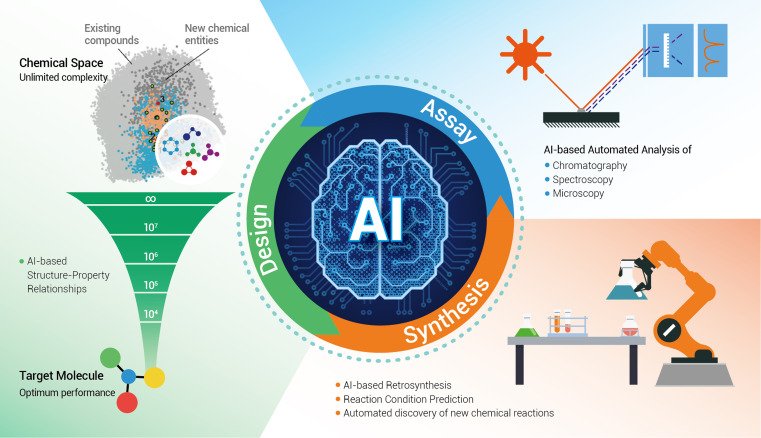
These systems generally begin with large collections of scientific information. This can include research papers, abstracts, datasets, citations, patents, technical reports, and other scholarly resources.
AI models can extract important concepts from this information and organize them into structured relationships. Knowledge graphs are particularly useful because they represent scientific entities and the connections between them.
AI Research Discovery Maps and Scientific Concepts
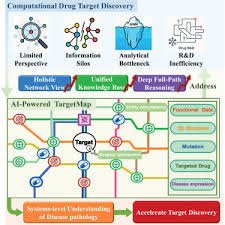
The first step is identifying important concepts. AI can examine scientific text and recognize terms, methods, materials, diseases, technologies, variables, and research questions.
For example, an AI system studying climate research might identify relationships between extreme weather, atmospheric temperature, renewable energy, carbon emissions, and energy demand.
The next step is finding connections between concepts. Some relationships are already well established, while others may be less explored.
A research map can help researchers distinguish between mature research areas and emerging combinations of ideas.
AI Research Discovery Maps and Future Research Directions
Once historical relationships are organized, machine learning models can analyze patterns and estimate which combinations may become interesting research directions.
A 2026 study in Nature Machine Intelligence demonstrated an approach using large language models and concept graphs to identify links that humans may not have noticed and suggest near- and medium-term research directions in materials science.
7 Powerful Benefits of AI Research Discovery Maps
1. Find Hidden Scientific Connections
One of the most powerful uses of these systems is finding relationships between scientific concepts.
Researchers usually work within specialized fields. This can make it difficult to follow developments across every related discipline. AI can process information from multiple research areas and identify connections between them.
For example, a development in computer science could potentially influence materials science, medicine, energy research, or environmental science.
Reveal Overlooked Ideas
Some connections may receive little attention even though they could become useful. AI can highlight these less-explored relationships and give researchers new directions to investigate.
However, an unusual connection is not automatically a valuable discovery. Researchers still need to determine whether the relationship is scientifically meaningful.
2. Identify Emerging Research Trends
Scientific fields continuously change. Some topics become less active, while others grow rapidly.
AI-based research maps can analyze publication patterns and concept relationships to identify areas that are gaining attention.
Track Growing Topics
Suppose a technology appears in only a small number of papers initially. Over time, researchers from different disciplines may begin using it.
An AI system can detect this expansion and indicate that the topic may be becoming an emerging research area.
This can help researchers, universities, and organizations understand where scientific interest is moving.
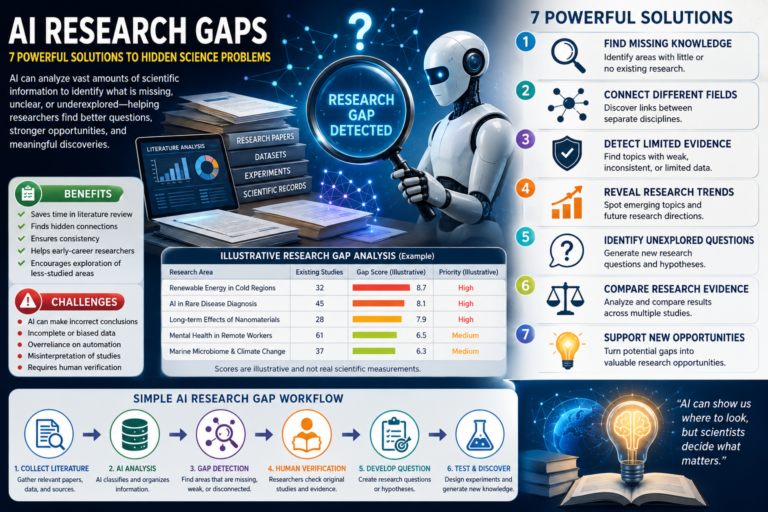
3. Help Find Research Gaps
Another important advantage is identifying areas where existing research may be limited.
A map may show that two scientific concepts have strong relationships individually but very few studies connecting them.
Highlight Missing Links
These missing links can become possible research opportunities.
For example, researchers may discover that a particular material has been studied extensively for energy storage but rarely examined alongside a specific AI optimization technique.
That gap does not guarantee a successful research project, but it can provide a useful starting point for developing a research question.
4. Support Cross-Disciplinary Research
Many modern scientific challenges cannot be solved by one discipline alone.
Climate change, clean energy, drug discovery, robotics, and advanced materials all require knowledge from multiple fields.
Connect Different Fields
AI can analyze concepts across disciplinary boundaries and identify possible connections.
For example, a researcher working on renewable energy could explore relationships between artificial intelligence, weather forecasting, battery storage, smart grids, and materials science.
This broader perspective can encourage researchers to investigate ideas outside their traditional specialization.
5. Improve Research Planning
Choosing a research topic can be difficult when thousands of studies already exist.
AI research mapping can give researchers a broader view of a field before they begin a new project.
Show Research Opportunities
Researchers can use these maps to examine established topics, emerging areas, crowded research fields, and less-explored connections.
This can help them make more informed decisions about which research questions deserve additional attention.
Instead of starting with a completely blank page, researchers can begin with a structured view of the existing scientific landscape.
6. Accelerate Scientific Discovery
Modern research produces an enormous amount of information. No individual researcher can realistically read every relevant publication.
AI can process large collections of scientific literature much faster and organize the information into useful relationships.
Reduce Information Overload
This does not mean AI replaces researchers. Instead, it can help researchers navigate the growing amount of scientific knowledge.
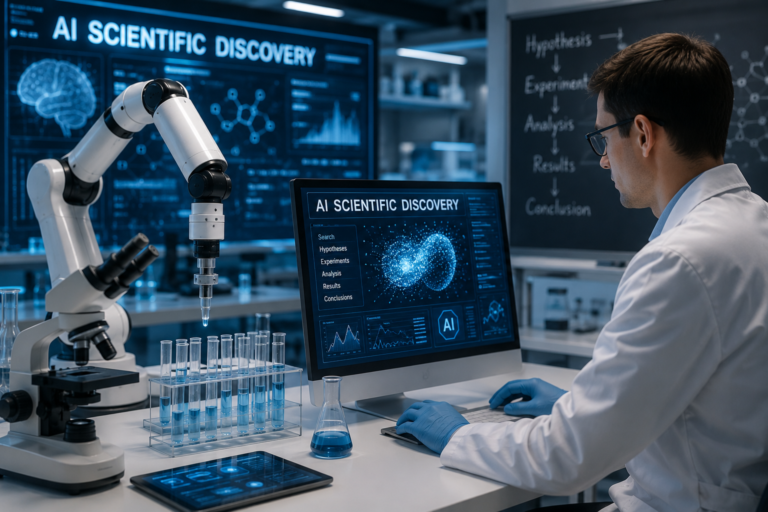
Modern AI-for-science workflows increasingly combine literature research, data analysis, hypothesis generation, experiments, and scientific reporting.
This makes research mapping potentially valuable as an early-stage discovery tool.
7. Predict Possible Future Directions
The most exciting possibility is using historical research patterns to estimate what could become important next.
AI can examine how scientific concepts have developed and identify combinations that appear promising.
AI Research Discovery Maps and Future Science
For example, if two research concepts have been growing independently, an AI model may identify a possible opportunity for combining them.
ResearchLink, a knowledge-graph-based approach published in 2025, explored automated research hypothesis generation by combining graph-based information with text and bibliometric information.
Such systems show how scientific knowledge can be transformed into structured information that AI can use for hypothesis and discovery support.
Research Comparison Table
| Research Task | Traditional Method | AI Research Discovery Maps |
|---|---|---|
| Finding research topics | Manual searching | AI-supported trend analysis |
| Finding connections | Researcher observation | Concept relationship analysis |
| Finding research gaps | Literature comparison | Automated relationship mapping |
| Tracking trends | Citation and publication review | AI-assisted pattern detection |
| Cross-field research | Manual exploration | Connected concept discovery |
| Future directions | Expert prediction | Data-supported forecasting |
| Hypothesis development | Researcher brainstorming | AI-assisted idea generation |
The table shows that AI research mapping mainly improves the discovery and exploration stage. Scientific judgment, experimentation, and validation are still necessary.
AI Research Discovery Maps: Illustrative Trend Graph
The following graph is an illustrative example, not measured scientific data. It shows how an AI system might represent the relative growth of research interest across different stages.
Illustrative Research Interest

Emerging
Research
Interest
  ^
  |                              ██████████
  |                         █████████
  |                    ███████
  |               ██████
  |          █████
  |     ████
  | ███
  +----------------------------------------> Time
    Early       Growing       Emerging       Future
The important idea is that AI research mapping can analyze historical information and identify patterns that may point toward emerging areas. These systems should be treated as research-support tools rather than guaranteed prediction systems.
Challenges of AI Research Discovery Maps
Despite their potential, AI research maps have important limitations.
Cannot Guarantee the Future
A predicted research direction may never become important. Scientific progress is influenced by experiments, funding, technological breakthroughs, unexpected discoveries, and human decisions.
Therefore, an AI prediction should be considered a possibility rather than a fact.
Can Reflect Biased Data
If an AI system learns from existing publications, it can inherit weaknesses in that literature.
Fields with more publications may receive more attention, while valuable research areas with fewer publications could appear less important.
Need Reliable Evidence
AI-generated relationships must be checked against original scientific evidence.
A connection that looks convincing mathematically or visually may not have a meaningful scientific explanation.
This is why human researchers remain essential for interpretation, validation, and experimental testing.
Future of AI Research Discovery Maps
The future of AI Research Discovery Maps could become even more advanced as scientific AI systems improve.
Future systems may combine research papers, experimental data, patents, simulations, laboratory results, and real-time scientific information into continuously updated maps.
Could Become Dynamic
Instead of creating a map once, future systems could update research maps whenever new scientific evidence becomes available.
This could allow researchers to monitor emerging concepts almost continuously.
Could Support Autonomous Research
AI-generated hypotheses are increasingly being connected with experimental systems. Research is moving toward more complete AI-assisted discovery cycles in which models can generate ideas, analyze information, and help guide experiments.
Another emerging direction combines AI hypothesis generation, agentic reasoning, and autonomous laboratory platforms to support closed-loop scientific discovery.
This suggests that future research maps may not only show where science is going but could also help decide which ideas should be tested next.
Conclusion: AI Research Discovery Maps
AI Research Discovery Maps are becoming an interesting approach to understanding the rapidly expanding scientific landscape. They can organize complex research information, reveal hidden connections, identify research gaps, track emerging trends, and suggest possible future directions.
Their greatest value is not in perfectly predicting the future. Instead, they can help researchers see possibilities that might otherwise remain hidden within millions of scientific publications.
However, AI predictions should never be accepted without verification. A promising research connection still needs scientific reasoning, reliable evidence, experiments, and independent validation.
The future of scientific discovery may therefore combine human creativity with AI-powered research mapping. When used carefully, these systems could become a powerful tool for finding the next important questions in science.
FAQs About AI Research Discovery Maps
What Are AI Research Discovery Maps?
They are AI-supported systems that organize scientific concepts and relationships to help researchers understand existing knowledge and identify possible emerging research directions.
How Do AI Research Discovery Maps Predict Future Science?
They analyze historical research, scientific concepts, relationships, publication patterns, and other information to identify combinations or trends that may become important in the future.
Are AI Research Discovery Maps Accurate?
They can provide useful research suggestions, but they cannot guarantee future scientific outcomes. Researchers must verify AI-generated predictions using evidence and experiments.
Can AI Research Discovery Maps Find Research Gaps?
Yes. They can identify areas where scientific concepts have few documented connections, which may help researchers discover possible research gaps.
Can AI Research Discovery Maps Replace Scientists?
No. They can support literature analysis, trend discovery, and research planning, but scientists are still needed to evaluate ideas, design experiments, interpret results, and make scientific judgments.
Why Are AI Research Discovery Maps Important?
They can help researchers manage the growing amount of scientific information and discover relationships that may be difficult to identify through traditional literature searches alone.
What Is the Future of AI Research Discovery Maps?
Future systems may become dynamic and continuously updated, connecting scientific literature with datasets, simulations, patents, and experimental results. This could make them an important component of AI-assisted scientific discovery.