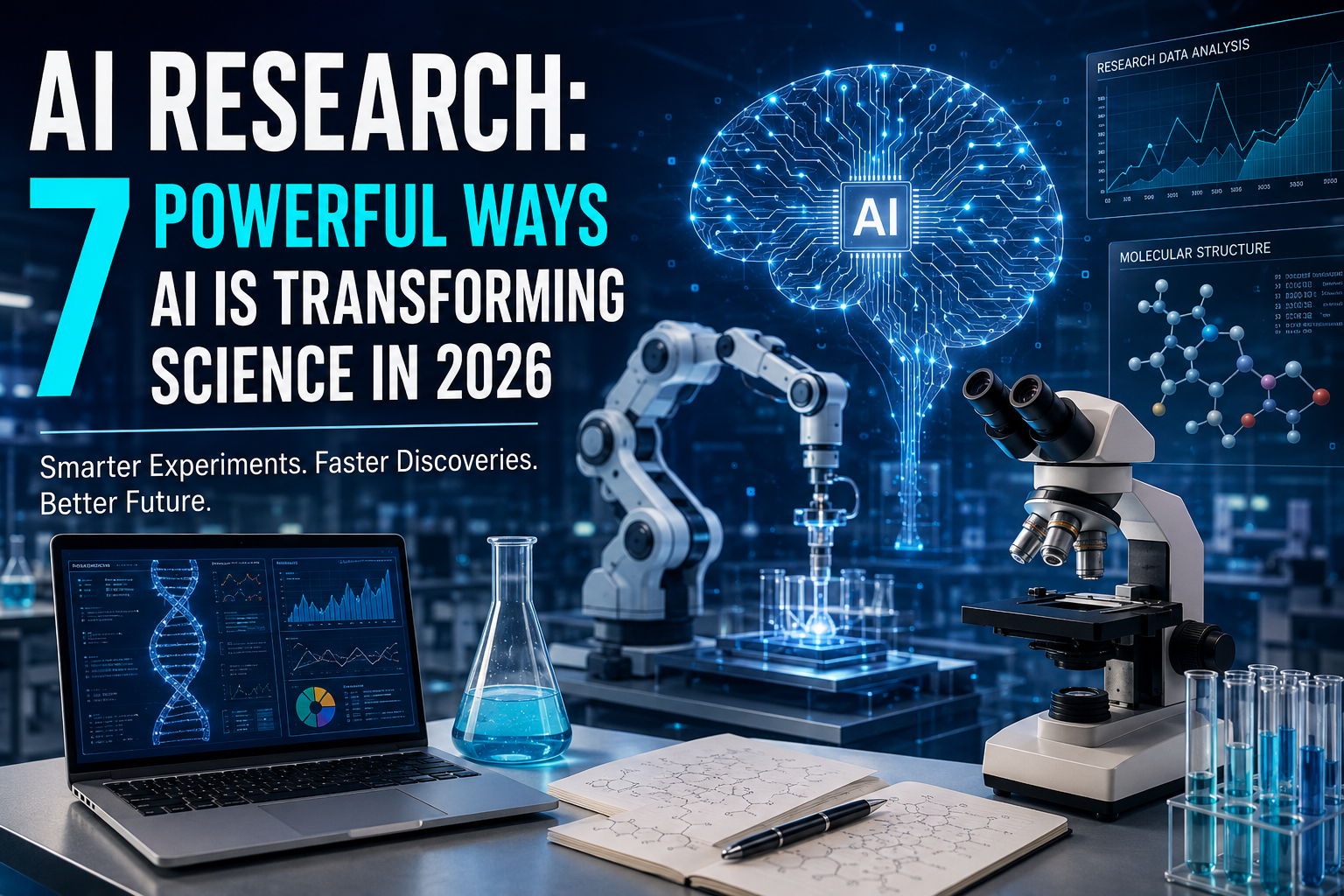
AI Research: 7 Powerful Ways AI Is Transforming Science in 2026
AI Research is being transformed rapidly in 2026. Scientific papers are being analyzed with advanced AI systems, new research ideas are being generated, and laboratory experiments are increasingly being automated. Moreover, large scientific datasets are being processed at a speed that was difficult to achieve with traditional methods. As a result, researchers are being provided with powerful tools that can support faster and more efficient scientific discovery.
Table of Contents
- What Is AI Research?
- 7 Ways AI Is Changing Science
- AI Literature Research
- AI-Generated Research Ideas
- Automated Experiments
- Self-Driving Laboratories
- Challenges and Future
- FAQs
- Conclusion
What Is AI Research?

AI Research refers to the use of artificial intelligence to support scientific research. AI can be used to analyze scientific papers, identify patterns, generate hypotheses, plan experiments, process datasets, and assist with scientific discovery.
Previously, many research tasks were performed manually. Thousands of papers could take researchers weeks or months to examine. Similarly, large datasets could require extensive computing resources and human analysis.
Now, some of these tasks are being supported by AI.
Furthermore, AI agents are being developed that can perform several research tasks within connected workflows. Scientific literature can be searched, research ideas can be proposed, and experimental results can be analyzed.
However, human judgment is still required. AI-generated results must be checked before they can be treated as reliable scientific evidence.
7 Powerful Ways AI Research Is Changing Science
AI Research Is Accelerating Literature Analysis

Scientific literature has grown enormously. Researchers may need to examine hundreds or thousands of papers before a new project is started.
With AI Research, large collections of scientific literature can be searched and analyzed more efficiently.
AI systems can be used to identify important findings, compare studies, and connect information from different research areas.
A 2026 Nature study examined an AI multi-agent system called Robin. The system was used to analyze scientific literature as part of a biological research workflow. According to the study, 551 papers were analyzed in around 30 minutes, while the researchers estimated that the equivalent manual task would have required roughly 294 hours.
Therefore, AI-assisted literature research could significantly reduce the time needed to locate relevant scientific information.
New Research Ideas Are Being Generated
Another important development in AI Research is automated hypothesis generation.
A research project normally begins with a question or hypothesis. Evidence is then collected and experiments are designed to test the idea.
Now, AI systems are being used to examine existing scientific knowledge and propose possible research directions.
In the 2026 Robin study, potential treatment ideas for dry age-related macular degeneration were generated from scientific literature. One candidate, ripasudil, was subsequently tested in laboratory experiments.
This demonstrates how AI can be connected to experimental research.
Nevertheless, an AI-generated hypothesis is not automatically a scientific discovery. It must still be tested and independently verified.
AI Research Is Automating Experiments
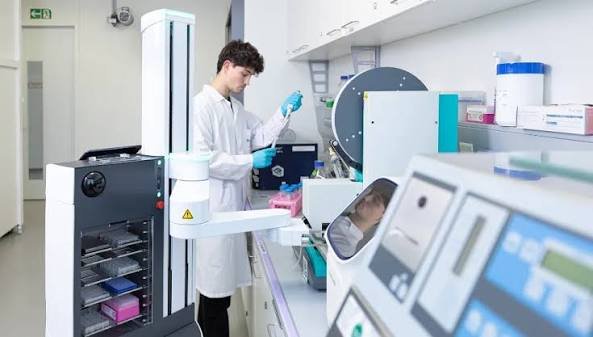
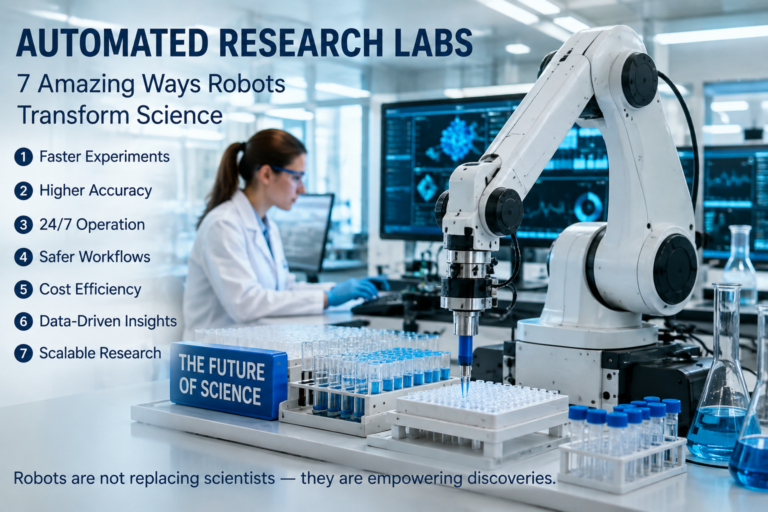
Laboratory automation is becoming another important part of AI Research.
Robotic equipment can already perform repetitive tasks. However, AI can be connected to these systems so that experimental decisions can also be supported by software.
In 2026, research on the AutoLabs system described a self-correcting multi-agent architecture for autonomous chemical experimentation. Natural-language instructions were converted into laboratory procedures that could be carried out using automated equipment.
As a result, some repetitive laboratory processes can be performed with less direct human intervention.
The system can also help detect problems and adjust procedures.
Therefore, automated research could become increasingly useful for experiments that need to be repeated many times.
Large Scientific Datasets Are Being Processed
Modern research can produce enormous datasets.
Genomics, astronomy, climate science, materials science, and particle physics can all generate information at a scale that is difficult to examine manually.
AI models can be trained to identify patterns within these datasets.
For example, scientific measurements can be classified, compared, or used to create predictions.
A 2026 study examined more than five million scientific publications to investigate the relationship between AI, high-performance computing, and scientific discovery.
The research shows how AI and advanced computing are increasingly being connected with modern scientific workflows.
However, patterns detected by AI still need to be interpreted carefully.
A statistical relationship does not necessarily prove a scientific cause.
AI Research Is Being Used With Scientific Instruments
AI Research is also moving into physical research facilities.
Scientific instruments can be complex. Researchers may need to adjust settings repeatedly before useful measurements are obtained.
In 2026, an AI system was demonstrated for autonomous X-ray sample alignment at a synchrotron beamline. The system was designed to plan actions, operate instruments, interpret observations, and adjust its behavior when conditions changed.
This development is significant because scientific instruments can require highly precise control.
If some of these operations are automated, researchers may be able to spend more time on higher-level scientific questions.
At the same time, safety systems and human supervision remain important.
Self-Driving Laboratories Are Being Developed
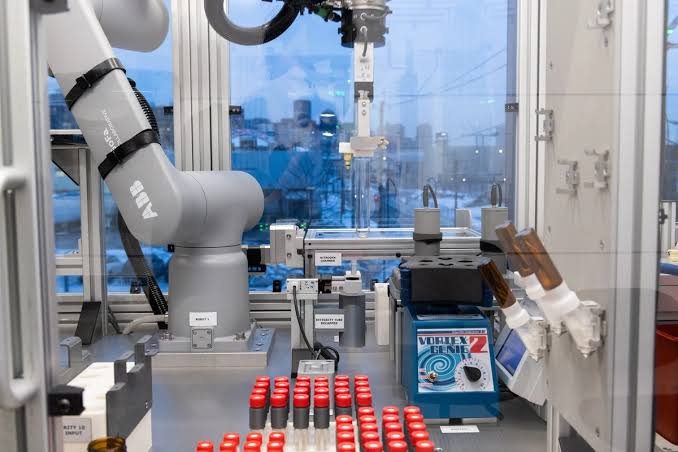
One of the most advanced areas of AI Research is the development of self-driving laboratories.
A self-driving laboratory combines AI, robotics, automated instruments, and data analysis.
Instead of following only a fixed experimental sequence, the system can potentially select the next experiment based on the results of previous experiments.
For example, a material may be tested and found to have weak performance. The AI system can then use that result to select another material composition for testing.
The new result can then be analyzed again.
Consequently, an experimental feedback loop can be created.
A 2026 review in Nature Reviews Chemistry discussed self-driving laboratories as systems in which autonomous experimentation, robotics, reactor engineering, and AI are being combined to accelerate scientific research.
The technology is developing quickly, but several challenges remain.
AI Research Can Connect Multiple Research Tasks
Traditionally, research tasks are often separated.
Literature may be searched by one researcher. Experiments may be performed by another team. Data may then be analyzed separately.
AI can potentially connect these stages.
A March 2026 study described an AI Scientist pipeline designed to automate several stages of computer-based research, including idea generation, coding, experiments, data analysis, manuscript preparation, and peer review.
This suggests that future research systems could be designed as connected workflows rather than isolated tools.
However, such systems still require careful evaluation.
AI Research and Scientific Efficiency
One of the biggest advantages of AI Research may be improved efficiency.
Scientific information can be searched quickly. Large datasets can be processed automatically. Repetitive experiments can also be performed by robotic systems.
Research Workflow Comparison
| Research Task | Traditional Approach | AI-Assisted Approach |
|---|---|---|
| Literature search | Manual paper reading | AI-assisted searching and analysis |
| Hypothesis development | Human-led | AI-supported idea generation |
| Data analysis | Manual and computational | AI-assisted pattern detection |
| Repetitive experiments | Human-operated | Robotic automation |
| Instrument control | Manual adjustment | AI-assisted control |
| Research workflow | Separate stages | Connected AI workflows |
The table shows how different research activities can be supported by AI.
However, the level of automation differs between scientific fields. Some tasks can already be automated, while others still require substantial human involvement.
AI Research: Selected 2026 Research Examples
The following table highlights selected examples reported in 2026 research.
| Research Example | Reported Result | Research Area |
|---|---|---|
| Robin AI research system | 551 papers analyzed | Biological research |
| Robin manual comparison | About 294 hours estimated | Literature research |
| AI + HPC study | More than 5 million publications examined | Scientific research |
| AutoLabs | Automated chemical experimentation | Chemistry |
| Autonomous X-ray alignment | AI-controlled instrument workflow | Physics |
These examples should not be treated as a direct comparison of overall AI performance. Each study used different methods and research goals.
Graph: AI Research at Different Scales
The following graph represents selected numerical examples reported in 2026 studies. It is intended to show research scale, not to claim that the tasks are directly comparable.
Selected 2026 AI Research Examples

Publications analyzed
5,000,000 | ██████████████████████████████████████████████████
          |
Papers analyzed
551       | █
          |
Estimated manual hours
294       | █
          |
          +--------------------------------
            Reported scale in each study
The difference in scale demonstrates how AI can be applied to both focused research tasks and very large scientific datasets.
Therefore, AI is not limited to one type of scientific work.
Low-Competition AI Research Keywords
For a research website, specific long-tail keywords can be targeted instead of competing only for the broad phrase AI Research.
Useful keywords include AI Research 2026, AI scientific research tools, AI research agents, AI hypothesis generation, AI automated research, and AI self-driving laboratories.
These phrases are more specific and can help attract readers searching for particular research applications.
Keyword placement should remain natural. Excessive repetition should be avoided because readability and usefulness are more important than keyword density alone.
Challenges in AI Research
Despite its benefits, AI Research also creates important challenges.
AI systems can produce incorrect information. A generated hypothesis may sound convincing while being scientifically weak.
Data quality can also affect results.
If incomplete or biased data is used, misleading patterns may be produced.
Another challenge is reproducibility.
Scientific findings need to be repeatable so that they can be independently verified.
Furthermore, automated laboratories can generate large quantities of experimental data. That information must still be interpreted correctly.
Therefore, human oversight remains essential.
Human Scientists Are Still Important
AI should not simply be viewed as a replacement for scientists.
Instead, it can be used as a research assistant.
Routine analysis can be automated. Large collections of information can be searched quickly. Potential research directions can also be suggested.
Scientists can then focus more attention on research questions, experimental design, interpretation, ethics, and validation.
This combination could provide a stronger model for future scientific research.
The Future of AI Research
The future of AI Research is likely to involve greater cooperation between humans, AI agents, robots, and scientific instruments.
Research literature may be searched automatically.
Potential hypotheses could then be generated.
Experiments could be selected and performed by automated systems.
Results could be analyzed and used to design the next experiment.
This could create a continuous research cycle.
However, responsible development will be necessary.
Research systems will need strong validation procedures, transparent records, reliable datasets, and human supervision.
If these requirements are met, AI could become a powerful part of the scientific research process.
Frequently Asked Questions
What is AI Research?
AI Research is the use of artificial intelligence to support scientific activities such as literature analysis, hypothesis generation, experiment planning, data analysis, and discovery.
Can AI generate scientific research ideas?
Yes. AI systems are being developed to analyze scientific knowledge and generate possible hypotheses. These ideas must still be tested experimentally.
Can AI perform scientific experiments?
Yes, in some automated laboratories. AI can be connected with robotic equipment to support experimental planning and execution.
What are self-driving laboratories?
Self-driving laboratories combine AI, robotics, automated instruments, and data analysis so that experiments can be planned and adjusted with limited manual intervention.
Can AI replace scientists?
No. Human scientists are still needed for scientific judgment, research design, safety, interpretation, and validation.
Is AI Research accurate?
AI can be useful, but its results are not automatically accurate. Scientific findings must be independently checked and validated.
Why is AI Research important in 2026?
AI is being used to analyze scientific literature, process large datasets, generate hypotheses, automate experiments, and operate research instruments.
Conclusion
AI Research is changing the way scientific work is being performed in 2026.
Scientific literature can be analyzed faster. New hypotheses can be generated with AI assistance. Laboratory experiments can be automated, and complex datasets can be processed more efficiently.
Moreover, self-driving laboratories are being developed in which AI, robotics, and scientific instruments are connected within a single research workflow.
However, speed alone should not define scientific progress.
Reliable results must be tested, reproduced, and reviewed.
Therefore, the most promising future may be based on collaboration between AI and human researchers rather than complete replacement.
As AI systems become more capable, AI Research could help researchers explore difficult questions, reduce repetitive work, and accelerate the journey from a scientific idea to a tested discovery.