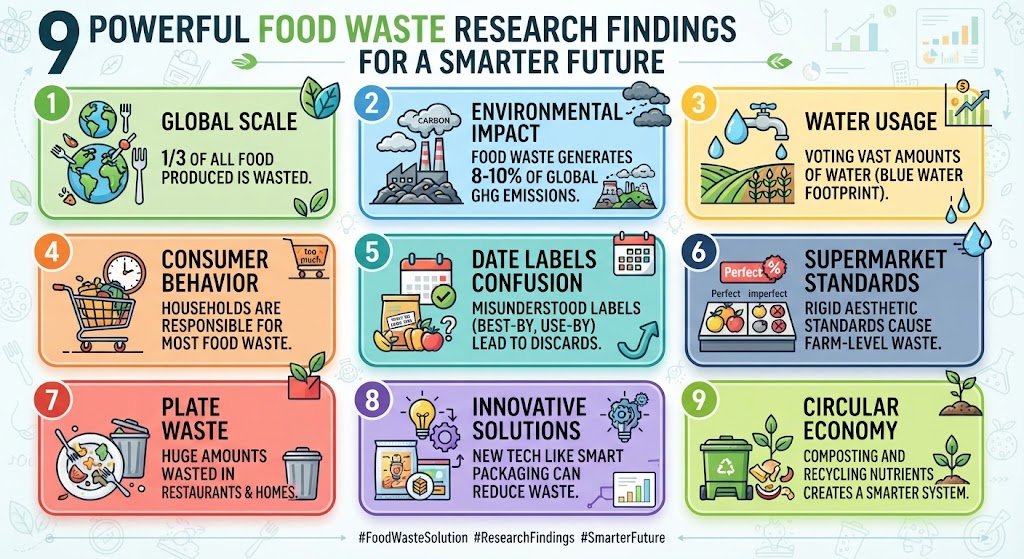
9 Powerful Food Waste Research Findings for a Smarter Future
Food waste is becoming one of the most important sustainability challenges of the modern food system, and recent Food Waste Research shows that technology could play a major role in reducing it. UNEP estimates that 1.05 billion tonnes of food were wasted at the retail, food-service, and household levels in 2022, equal to about 19% of food available to consumers. The latest research is increasingly examining how artificial intelligence, smart sensors, improved cold chains, predictive analytics, and digital tracking can help prevent edible food from becoming waste.
Table of Contents
- Food Waste Research Shows the Scale of the Problem
- Food Waste Research on Household Waste
- Food Waste Research and Artificial Intelligence
- Food Waste Research on Smart Sensors
- Food Waste Research and Cold Chain Technology
- Food Waste Research on Smart Packaging
- Food Waste Research and Food Redistribution
- Food Waste Research on Data and Predictive Analytics
- Food Waste Research and Circular Technology
- The Future of Food Waste Research
- Conclusion
Food Waste Research Shows the Scale of the Problem
Recent Food Waste Research demonstrates that food waste is not limited to supermarkets or restaurants. It happens throughout the consumer food system, with households representing the largest share.
According to UNEP’s 2024 Food Waste Index, households accounted for approximately 60% of global food waste in 2022, while food services accounted for 28% and retail accounted for 12%. In total, the three sectors generated around 1.05 billion tonnes of food waste.
| Sector | Food Waste in 2022 | Share |
|---|---|---|
| Households | 631 million tonnes | 60% |
| Food service | 290 million tonnes | 28% |
| Retail | 131 million tonnes | 12% |
| Total | 1.05 billion tonnes | 100% |
This data is important because it shows why technology alone cannot solve the problem. Food waste needs changes across households, restaurants, retailers, supply chains, infrastructure, and public policy.
Food Waste Research on Household Waste
One of the clearest findings in Food Waste Research is the importance of household behavior. UNEP’s data indicates that households generated about 631 million tonnes of food waste in 2022, representing around 60% of the total measured at retail and consumer levels.
Technology can help households understand what is being wasted and why. Smartphone applications, connected refrigerators, digital shopping lists, smart labels, and AI-powered meal-planning tools can potentially help consumers make better decisions before food expires.
The challenge is that technology must be easy to use. A complicated application that requires users to manually record every item in their refrigerator may not be practical for everyday life. Future systems could therefore rely more on automation, computer vision, barcode scanning, and connected sensors.
Food Waste Research and Smarter Household Planning
Research into digital food management suggests that better information can help people make more informed decisions. A smart system could identify food that is approaching its expected shelf-life and suggest recipes or reminders before the item is discarded.
This approach changes the role of technology from simply recording waste to helping prevent it.
Food Waste Research and Artificial Intelligence
Artificial intelligence is becoming one of the most interesting areas of Food Waste Research. AI can analyze large amounts of information and identify patterns that humans may overlook.
In food supply chains, machine-learning systems can analyze historical sales, weather conditions, seasonal demand, inventory levels, and other information to estimate how much food will be needed.
A 2025 study indexed by FAO AGRIS examined AI-driven systems combining machine learning and IoT data for crop-yield prediction, demand forecasting, and shelf-life monitoring. The study reported promising results from its proposed framework, although its findings should be understood as research results from that specific system rather than a universal estimate for all food operations.
Food Waste Research on AI Spoilage Prediction
AI can also be used to estimate when perishable food may become unsuitable for sale or consumption. Computer vision and sensor data can help identify changes in appearance, temperature, humidity, or other conditions associated with deterioration.
A 2025 review indexed by FAO AGRIS highlighted predictive analytics, early spoilage detection, dynamic storage optimization, and real-time environmental data as important AI applications for reducing food waste.
These technologies are particularly relevant to products such as fruits, vegetables, dairy, meat, and prepared foods because their quality can change quickly.
Food Waste Research on Smart Sensors
Another important area of Food Waste Research involves Internet of Things sensors. Small sensors can continuously monitor environmental conditions that influence food quality.
Temperature and humidity are particularly important during storage and transportation. If a refrigerated shipment becomes too warm for an extended period, the information can potentially be detected before the entire shipment is lost.
Connected sensors can send alerts to logistics teams, warehouse operators, retailers, or farmers. This creates an opportunity to respond earlier instead of discovering the problem after food has already spoiled.
Food Waste Research and Real-Time Monitoring
Real-time monitoring is especially useful for supply chains involving fresh produce. Instead of relying only on scheduled inspections, connected systems can continuously collect information.
Research into postharvest technologies is also examining IoT sensors, AI, blockchain, and digital twins as tools for improving traceability, forecasting, and operational efficiency across food supply chains.
Food Waste Research and Cold Chain Technology
Cold-chain infrastructure is another major focus of Food Waste Research. Perishable foods require controlled temperatures from production through transportation, storage, retail, and sometimes delivery.
FAO reported in March 2026 that inadequate refrigeration contributes to an estimated 526 million tonnes of food being lost or wasted globally, representing around 12% of the global total. The organization highlighted temperature-controlled storage, transportation, and decentralized solar-powered cooling as potential parts of the solution.
This is particularly important in regions where electricity supplies can be unreliable or where farmers lack access to affordable refrigeration.
Food Waste Research and Solar Cold Storage
Solar-powered cold storage can provide an alternative in locations where conventional grid infrastructure is limited. Instead of allowing harvested produce to deteriorate quickly, farmers can use temperature-controlled storage to extend the time available for transportation and sale.
FAO’s recent work also highlights sustainable cooling technologies and solar-powered cold storage as promising options for reducing postharvest losses, particularly in remote and developing regions.
Food Waste Research on Smart Packaging
Packaging technology is another area attracting attention in Food Waste Research. Traditional packaging primarily protects food from physical damage, but newer approaches can provide additional information about freshness and storage conditions.
Smart labels can potentially communicate changes in temperature or freshness. Active packaging can also be designed to help maintain product quality for longer periods.
UNEP has previously highlighted smart labelling, active packaging, solar-powered cold storage, and other digital and green technologies as potential tools for reducing food waste.
The objective is not simply to make packaging more technologically advanced. The important question is whether the technology helps consumers and businesses make better decisions about when food should actually be consumed, sold, donated, or discarded.
Food Waste Research and Food Redistribution
Technology can also help redirect surplus food before it becomes waste. Digital platforms can connect businesses that have excess food with organizations or consumers who can use it.
A 2025 FAO project in Medellín, Colombia, explored digital innovations and partnerships for reducing food loss and waste. The project reported that a major wholesale market had reduced daily waste from 90 tonnes to 40 tonnes through partnerships with food banks. It also examined an AI-driven platform for surplus-food redistribution.
This demonstrates an important principle in Food Waste Research: preventing waste is not always about improving the food itself. Sometimes the solution is improving the connection between surplus food and people who can use it.
Food Waste Research on Data and Predictive Analytics
Data is becoming a foundation of modern Food Waste Research. Businesses cannot effectively reduce waste if they do not know where, when, and why it happens.
FAO’s Food Loss and Waste Database contained almost 40,000 data points from 167 countries as of January 2026, covering hundreds of commodities and thousands of publications and reports.
This type of data can help researchers identify patterns across regions and food categories.
FAO has also introduced Optiwaste, a data-driven tool launched in 2025 that helps food-service organizations record, analyze, and understand food waste. The tool is designed to help organizations identify where and when waste occurs and develop targeted reduction strategies.
Food Waste Research and Predictive Inventory
Predictive inventory systems can potentially help retailers order more appropriate quantities of food. If a store consistently overestimates demand for a particular product, an analytics system could identify that pattern.
Similarly, a restaurant could analyze previous demand to improve purchasing and preparation decisions.
The purpose is not to eliminate uncertainty completely. Demand is affected by weather, holidays, local events, prices, and many other factors. Predictive systems can instead provide better information for decision-making.
Food Waste Research and Circular Technology
Not all food waste can be prevented. Some organic material will remain unavoidable, which makes circular technology another important part of Food Waste Research.
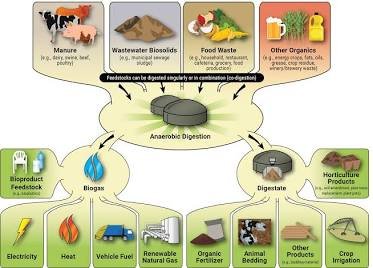
Organic waste can be processed through composting or anaerobic digestion. Anaerobic digestion can produce biogas that can be used to generate energy.
FAO’s 2026 discussion of sustainable food systems highlights the potential to connect food-waste management with biogas production, creating an opportunity to recover energy from unavoidable organic waste.
This approach does not replace prevention. Avoiding edible food waste is generally preferable to processing edible food after it has already been discarded. However, circular systems can provide a useful destination for material that cannot realistically be recovered for consumption.
The Future of Food Waste Research
The future of Food Waste Research is likely to combine several technologies instead of relying on one solution. AI can analyze demand, sensors can monitor storage conditions, smart packaging can provide freshness information, and digital platforms can connect surplus food with potential users.
UNEP’s 2026 reporting highlights AI solutions already being explored for commercial kitchens and food systems. One example discussed by UNEP is an AI-enabled kitchen waste system that uses images, weight, and cost information to help kitchens understand what they are throwing away. UNEP also reported a 62% reduction in post-consumer waste in a 2023 Green Breakfast initiative involving 13 participating hotels.
However, technology has limitations. AI systems require quality data, sensors require maintenance, and digital infrastructure requires investment. FAO research also identifies challenges such as data quality, legacy-system compatibility, and regulatory barriers.
This means the most effective future strategy will probably combine technology with better infrastructure, employee training, consumer awareness, measurement standards, and supportive policies.
Conclusion
The latest Food Waste Research shows that food waste is a massive global challenge, but it also reveals several promising technological pathways for reducing it. AI can improve forecasting and spoilage prediction, sensors can monitor food conditions, cold-chain technology can protect perishables, smart packaging can provide freshness information, and digital platforms can help redistribute surplus food.
The scale of the problem remains significant. UNEP estimates that 1.05 billion tonnes of food were wasted in 2022 across households, food service, and retail, with households accounting for the largest share.
The strongest opportunity is therefore not one revolutionary invention. It is the combination of measurement, better infrastructure, intelligent software, and practical human behavior. As technology becomes more affordable and research improves, these systems could help move the food industry toward a future where more of the food produced is actually consumed rather than unnecessarily wasted.