7 Powerful AI Research Breakthroughs: Hope & Risks
Table of Contents
- Introduction to AI Research Breakthroughs
- AI Research Breakthroughs in Scientific Discovery
- AI Research Breakthroughs in Drug Discovery
- AI Research Breakthroughs in New Materials
- AI Research Breakthroughs in Automated Laboratories
- AI Research Breakthroughs in Climate Science
- AI Research Breakthroughs in Data Analysis
- AI Research Breakthroughs: Hidden Risks
- Future of AI Research Breakthroughs
- Conclusion
Introduction to AI Research Breakthroughs
AI Research Breakthroughs are changing how scientists explore complex questions, analyze enormous datasets, and develop new solutions to global challenges. In 2026, artificial intelligence is becoming an increasingly important part of scientific research, from discovering potential medicines to predicting material properties and automating laboratory experiments. These developments offer hope for faster discoveries, but they also introduce hidden risks involving accuracy, research quality, privacy, and scientific responsibility.

Traditional scientific research can require years of experiments, careful observation, and repeated testing. Artificial intelligence can help researchers identify patterns, generate hypotheses, and investigate possibilities that might otherwise take considerable time to explore. However, an AI-generated prediction is not automatically a proven scientific discovery. Researchers must still verify important findings through reliable experiments and independent evaluation.
The growing importance of AI Research Breakthroughs therefore creates an important question: can intelligent systems accelerate scientific progress without weakening the quality and reliability of research? Understanding both the opportunities and limitations can help readers recognize which developments are genuinely promising and which still require further evidence.
1. AI Research Breakthroughs in Scientific Discovery
One of the most important AI Research Breakthroughs involves using intelligent systems to help scientists generate new research questions. Instead of simply searching existing publications, advanced systems can compare scientific findings, identify possible relationships, and suggest hypotheses for further investigation.
For example, a researcher studying a complicated biological process might use AI to examine thousands of published studies and identify a connection that deserves experimental testing. A physicist could use machine learning to analyze measurements from an experiment and identify patterns that are difficult to recognize through manual analysis alone.
Research published in Nature in 2026 described an AI system designed to carry out multiple stages of scientific work, including generating ideas, writing code, running experiments, analyzing results, and preparing research manuscripts. The work demonstrates how AI could contribute to a more automated research process, although reliable scientific evaluation remains essential.
The greatest benefit is not necessarily replacing scientists. Instead, AI can help researchers investigate more possibilities and spend additional time evaluating important questions. Its usefulness depends on the quality of the evidence, the methods used, and the ability of independent researchers to reproduce the results.
2. AI Research Breakthroughs in Drug Discovery
Drug discovery is another area where AI Research Breakthroughs could improve scientific research. Developing a new medicine traditionally requires extensive laboratory experiments, safety assessments, and clinical studies. Many potential drug candidates fail before reaching patients, making the process expensive and time-consuming.
AI can help scientists examine molecular structures, predict how compounds might interact with biological targets, and prioritize candidates for further investigation. These predictions can narrow the range of possibilities that researchers need to test in the laboratory.
For example, machine learning models can analyze molecular characteristics and identify compounds that deserve additional investigation. Researchers can then test those candidates to determine whether their predicted properties are accurate.
AI may also support the development of new antibiotics, treatments for difficult diseases, and more targeted therapeutic approaches. However, a promising computer prediction does not establish that a medicine is safe or effective in humans. Laboratory testing, clinical trials, and regulatory review remain necessary.
The hope is that AI Research Breakthroughs will help scientists make better use of research resources and identify promising treatments more efficiently. The hidden risk is that inaccurate predictions or incomplete biological data could direct researchers toward unsuitable candidates.

3. AI Research Breakthroughs in New Materials
Discovering new materials is an important scientific challenge because materials influence batteries, electronics, construction, transportation, and renewable energy systems.
AI Research Breakthroughs can help scientists predict material properties before producing every candidate experimentally. Machine learning systems can examine relationships between chemical composition, atomic structures, and characteristics such as strength, conductivity, stability, or heat resistance.

For example, researchers developing better battery materials may use AI to screen possible compounds for desirable properties. Instead of manufacturing and testing every candidate, they can prioritize materials that appear most promising based on available evidence.
AI can also assist with the design of catalysts, semiconductors, lightweight structures, and materials that could improve energy efficiency. These applications may shorten parts of the discovery process and help laboratories investigate a broader range of possibilities.
Nevertheless, computational predictions have limitations. A material that performs well in a simulation might be difficult to manufacture, expensive to produce, or unstable under real-world conditions. Experimental validation is therefore essential before a proposed material can be considered a practical breakthrough.
4. AI Research Breakthroughs in Automated Laboratories
Automated laboratories represent another major direction for AI Research Breakthroughs. These systems combine AI software with laboratory equipment, robotics, sensors, and automated data analysis.
A conventional experiment often requires researchers to prepare samples, operate equipment, record measurements, and interpret results manually. Automated systems can perform some of these activities with less direct intervention, depending on the laboratory setup.
In a more advanced workflow, AI can suggest an experiment, laboratory equipment can carry it out, and the resulting measurements can be analyzed to guide the next experiment. This creates a feedback loop in which each experiment helps determine what should happen next.
Such systems could be useful in chemistry, materials science, biotechnology, and pharmaceutical research. They may allow laboratories to investigate more experimental conditions while maintaining detailed records of procedures and outcomes.
However, automation introduces new challenges. Faulty equipment, poorly designed experiments, contaminated samples, or incorrect software instructions can affect results. Laboratories must establish safety procedures, monitor equipment performance, and maintain reliable records.
The most useful AI Research Breakthroughs in automated laboratories will combine efficient experimentation with strong human supervision and reproducible results.
5. AI Research Breakthroughs in Climate Science
Climate science involves enormous amounts of information collected through satellites, weather stations, ocean measurements, field studies, and computer simulations. AI Research Breakthroughs can help researchers process these complex datasets and identify patterns relevant to environmental change.
Machine learning can support weather forecasting, flood-risk analysis, wildfire monitoring, and the study of changing ecosystems. Researchers may also use AI to examine relationships between temperature, rainfall, land use, and other environmental variables.
For example, an AI model could analyze satellite observations to identify changes in vegetation or monitor the expansion of drought-affected areas. Scientists could then compare the model’s predictions with ground observations and other independent sources.
These tools may improve early-warning systems and help communities prepare for certain environmental hazards. They could also help researchers investigate potential strategies for reducing emissions and improving energy efficiency.
However, climate models depend on the quality and coverage of their data. Predictions can become less reliable when conditions differ substantially from those represented in the training data. AI should therefore complement established scientific methods rather than replace physical understanding and careful evaluation.
6. AI Research Breakthroughs in Scientific Data Analysis
Scientific research increasingly produces datasets too large or complicated for traditional analysis alone. AI Research Breakthroughs can help researchers organize information, recognize patterns, classify observations, and identify unusual results.
In astronomy, machine learning can help identify objects or events in large collections of telescope observations. In biology, AI can assist with analyzing cellular images and complex molecular data. In physics, machine learning can help process measurements generated by sophisticated experiments.
These applications are particularly valuable when researchers need to examine millions of observations or detect patterns that are difficult to identify manually.
AI can also assist with reviewing scientific literature, summarizing relevant findings, and identifying unanswered research questions. However, summaries must be checked against original publications because AI systems can misunderstand technical details, misrepresent conclusions, or generate incorrect references.
Research published in Nature in January 2026 examined AI use across 41.3 million scientific papers. The study reported that AI-augmented researchers produced more publications and received more citations, while the collective range of topics explored by science narrowed. These findings highlight the need to evaluate both individual productivity and the wider direction of scientific research.
The lesson is clear: faster analysis is useful only when it contributes to reliable knowledge and encourages researchers to investigate meaningful questions.
7. AI Research Breakthroughs in Scientific Collaboration
Scientific collaboration often requires researchers from different disciplines to exchange knowledge, compare evidence, and develop shared approaches to difficult problems. AI Research Breakthroughs may help make this process more efficient.
For example, an AI research assistant could help a materials scientist understand relevant findings from chemistry or help a medical researcher locate studies related to a biological mechanism. Such systems can organize information across disciplines and suggest connections that researchers may wish to investigate.
AI tools can also support coding, statistical analysis, literature searches, and the preparation of research documents. These capabilities may help smaller research teams work more efficiently when they have limited time or resources.
Nevertheless, AI-generated summaries can omit important disagreements or overlook limitations in the original studies. Researchers must examine primary sources, acknowledge the work of other scientists, and preserve appropriate standards of attribution.
Scientific collaboration also depends on human judgment, discussion, and independent criticism. AI can help researchers exchange information, but it cannot automatically guarantee that a conclusion is correct or that a research project represents a genuine advance.
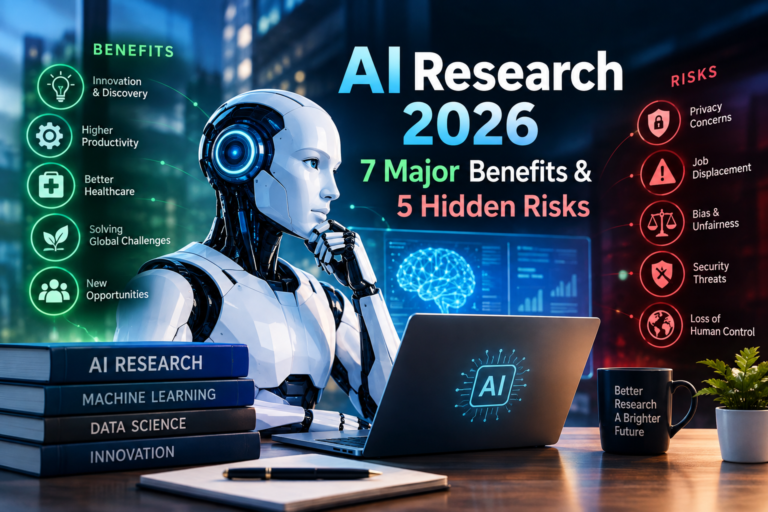
AI Research Breakthroughs: Benefits and Hidden Risks
AI Research Breakthroughs offer substantial opportunities, but their limitations deserve equal attention.
| Research area | Potential benefit | Important risk |
|---|---|---|
| Scientific discovery | Faster hypothesis generation | Unsupported conclusions |
| Drug discovery | Better candidate screening | Incorrect safety predictions |
| Materials science | Faster computational screening | Difficult real-world manufacturing |
| Automated laboratories | More efficient experiments | Equipment or software errors |
| Climate science | Improved data analysis | Uncertain predictions |
| Scientific data analysis | Faster pattern recognition | Bias or misleading results |
| Research collaboration | Easier access to information | Incorrect summaries and attribution |
One significant concern is data quality. If an AI system learns from incomplete, biased, or inaccurate information, its output may reproduce those weaknesses. Researchers must understand where their data originated and whether the information is suitable for the scientific question.
Another challenge is reproducibility. A scientific result becomes more trustworthy when independent researchers can follow the methods and obtain comparable findings. AI-generated research should therefore include transparent methods, appropriate documentation, and access to relevant data where possible.
There are also concerns about privacy, intellectual property, research misconduct, and the misuse of powerful scientific capabilities. Responsible oversight, security measures, and clear accountability are important safeguards.
The goal should not be to reject AI. Instead, scientific institutions should establish standards that encourage useful innovation while protecting the reliability and integrity of research.
Future of AI Research Breakthroughs
The future of AI Research Breakthroughs will likely involve deeper connections between intelligent software, scientific instruments, laboratory robotics, and specialized research databases.
As these systems improve, researchers may be able to move more efficiently from identifying a question to designing experiments and evaluating results. This could be especially valuable in fields where experiments are expensive, datasets are enormous, or the number of possible solutions is extremely large.
However, technological progress alone will not guarantee scientific success. Researchers will still need appropriate experiments, reliable measurements, independent review, and careful interpretation.
Access is another important issue. Well-funded institutions may have better computing resources, specialized equipment, and larger datasets than smaller universities or independent research groups. Making useful tools and scientific knowledge more accessible could help distribute the benefits more widely.
The most promising direction is human-guided scientific automation. In this approach, AI handles selected computational and repetitive tasks while researchers define meaningful questions, evaluate evidence, and remain responsible for conclusions.
Conclusion: AI Research Breakthroughs Bring Hope and Risks
AI Research Breakthroughs are opening new possibilities in scientific discovery, medicine, materials science, climate research, and automated experimentation. These developments can help researchers analyze information more efficiently, test promising ideas, and investigate questions that were previously difficult to approach.
At the same time, faster research can produce inaccurate conclusions when data are weak, experiments are poorly designed, or AI-generated results are accepted without independent verification. Scientific integrity, transparency, and human oversight must remain central to the research process.
In 2026, the real measure of AI progress should not simply be how quickly a system generates a hypothesis or produces a scientific paper. It should be whether the resulting work improves our understanding of the world and stands up to careful testing.
The future offers genuine hope, but lasting progress will depend on using AI responsibly. When researchers combine computational power with human expertise and reliable evidence, AI can become a valuable partner in the search for new scientific knowledge.