AI-Generated Hypotheses: 7 Surprising Ways to Improve Research
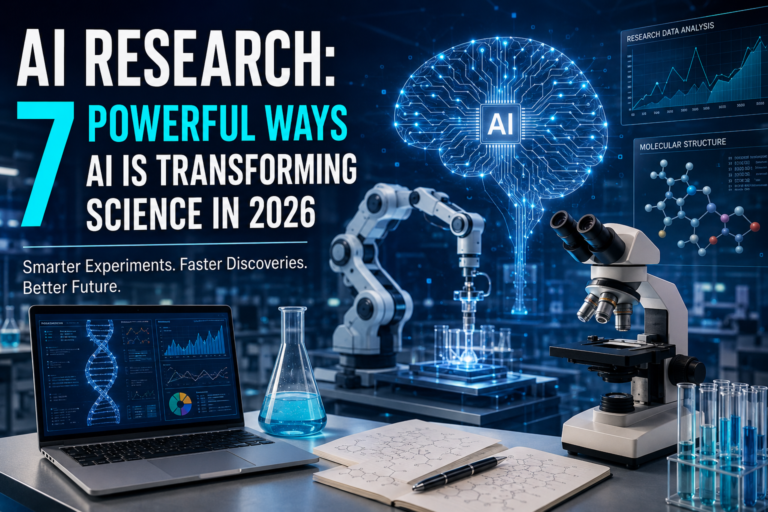
Research is changing quickly, and AI-Generated Hypotheses are becoming a useful way to discover new research ideas. Instead of depending only on traditional brainstorming, researchers can use artificial intelligence to analyze large amounts of information, identify hidden patterns, and suggest possible questions worth investigating. When these suggestions are carefully reviewed by researchers, they can make the research process faster, broader, and more creative.
Table of Contents
- What Are AI-Generated Hypotheses?
- 7 Ways AI-Generated Hypotheses Improve Research
- Challenges of AI-Generated Hypotheses
- Future of AI-Generated Hypotheses
- Conclusion
- FAQs
What Are AI-Generated Hypotheses?
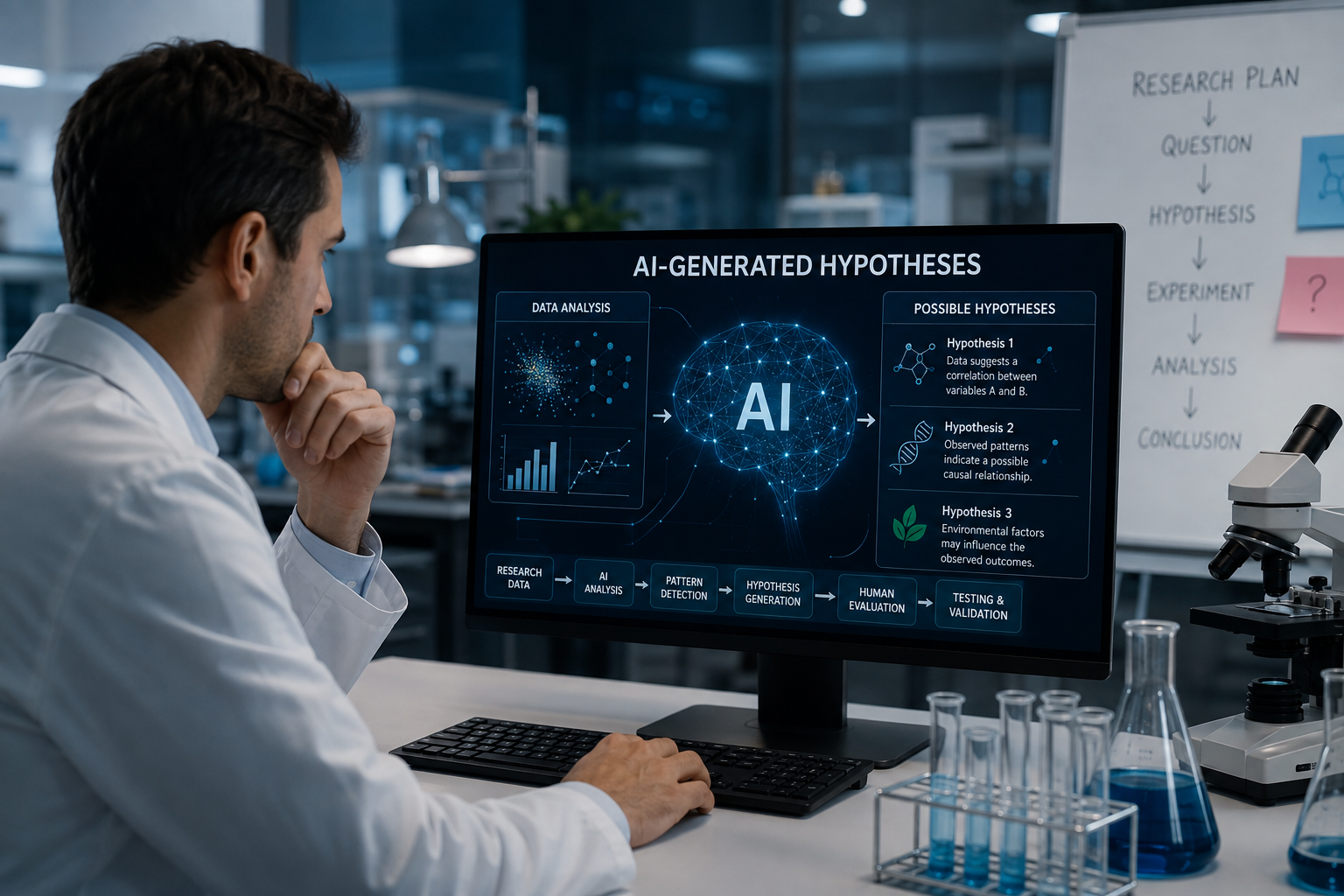
AI-Generated Hypotheses are possible research ideas or explanations created with the help of artificial intelligence. AI tools can analyze research papers, datasets, scientific information, and other sources to identify relationships that may be difficult for researchers to notice manually.
An AI-generated idea is not automatically a scientific fact. Researchers still need to test each hypothesis through experiments, observations, statistical analysis, or other suitable methods. Therefore, AI works best as a research assistant rather than a replacement for scientific judgment.
7 Ways AI-Generated Hypotheses Improve Research
1. Find Hidden Patterns

One of the most useful advantages of AI is its ability to process large amounts of information. A researcher may spend considerable time reading papers and comparing results, while AI can examine large collections of text and data much faster.
Pattern Discovery
AI can detect repeated relationships, unusual results, and connections between variables. These patterns can inspire researchers to ask new questions. For example, an AI system studying environmental data might identify a relationship between temperature changes and energy consumption that deserves further investigation.
This does not mean that every detected pattern is meaningful. Instead, the pattern becomes a starting point that researchers can investigate and verify.
2. Expand Research Ideas
Researchers can sometimes become focused on familiar theories or commonly studied questions. Artificial intelligence can introduce alternative possibilities by analyzing information from a wider range of sources.
Encouraging New Questions
AI may combine existing findings in unexpected ways. A researcher studying renewable energy, for example, could receive suggestions involving artificial intelligence, battery technology, weather forecasting, and power-grid optimization.
As a result, researchers may discover questions that would not have appeared during a traditional brainstorming session.
3. Improve Literature Reviews

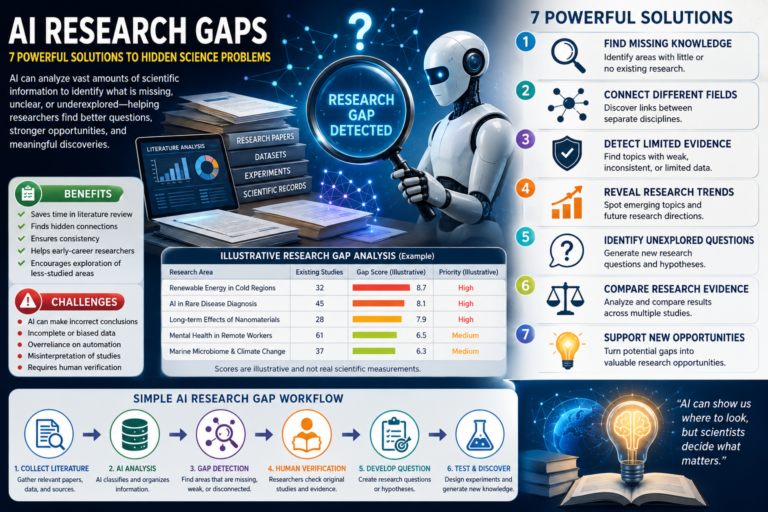
A literature review can be time-consuming because researchers need to understand what has already been studied. AI can support this process by helping researchers organize information and identify areas where evidence appears limited.
Identifying Research Gaps
When AI compares findings from different studies, it may highlight contradictions or areas that have received limited attention. These gaps can become possible research directions.
For example, if several studies reach different conclusions about the same phenomenon, AI may help identify variables that could explain those differences. Researchers can then develop a more focused hypothesis for testing.
4. Connect Different Fields
Some important discoveries happen when ideas from different disciplines are combined. AI can help create these connections because it can analyze information from multiple research fields.
Supporting Interdisciplinary Research
A single research question might involve biology, computer science, environmental science, and engineering. Humans can make these connections, but AI can help researchers explore them more efficiently.
This approach can encourage innovative research and create opportunities for new scientific methods and technologies.
5. Speed Up Research
Time is an important factor in modern research. AI-generated ideas can reduce the time required to move from a broad research topic to a testable question.
Improving Research Efficiency
Instead of starting with a blank page, researchers can ask AI to suggest possible explanations or relationships. The researcher can then compare these suggestions with existing evidence and select the most promising ideas.
This process does not remove the need for careful research. Instead, it can reduce repetitive work and allow researchers to spend more time on experiments, interpretation, and critical thinking.
6. Encourage New Perspectives
Another benefit of AI-assisted research is that AI can approach a research problem from different angles. A researcher may have one preferred explanation, while an AI system can suggest several alternative possibilities.
Challenging Existing Assumptions
These alternative ideas can encourage researchers to question assumptions and consider explanations they may have overlooked. This can be especially useful when a research problem has multiple possible causes.
The researcher must still determine whether these suggestions are logical, supported by evidence, and suitable for testing.
7. Support Data-Driven Research
Modern research often involves large and complicated datasets. AI can help researchers turn patterns within these datasets into questions that can be investigated.
AI and Data Analysis
For example, AI could analyze information from climate observations, laboratory experiments, or social research and identify a possible relationship between two variables. Researchers can then design an appropriate study to determine whether the relationship is genuine.
This makes AI particularly useful in research areas where large datasets are difficult to analyze manually.
Research Comparison
The following table shows how AI can support different stages of hypothesis development.
| Research Stage | Traditional Approach | AI-Assisted Approach |
|---|---|---|
| Finding ideas | Manual brainstorming | AI-supported idea generation |
| Literature review | Searching studies manually | Faster information analysis |
| Pattern discovery | Human observation | Large-scale data analysis |
| Research gaps | Manual comparison | AI-supported comparison |
| Hypothesis development | Researcher-led | Researcher and AI collaboration |
| Validation | Experiments and analysis | Experiments and analysis |
The important difference is that AI can make the early stages of research faster, while scientific testing remains essential.
AI-Generated Hypotheses Research Process
A simple research process can be represented as:
Research Data → AI Analysis → Pattern Detection → AI-Generated Hypotheses → Human Evaluation → Testing → Scientific Evidence
This process shows that these ideas are a starting point for investigation rather than a final scientific answer.
Challenges of AI-Generated Hypotheses
Although AI-generated ideas offer exciting opportunities, they also have limitations. AI systems can produce incorrect assumptions, misunderstand context, or identify relationships that appear interesting but have little scientific meaning.
Why Human Verification Matters
Researchers must examine the evidence behind an AI suggestion and determine whether the hypothesis can actually be tested. Bias in data can also influence AI-generated results.
For this reason, human judgment remains essential. AI can provide speed and new ideas, while researchers provide scientific knowledge, ethical judgment, and experimental validation.
Future of AI-Generated Hypotheses
The role of AI in research is likely to become more important as AI systems improve their ability to understand scientific literature and complex datasets.
Future research systems may be able to suggest more precise hypotheses, explain the evidence behind their suggestions, and recommend possible experiments for testing them.
Researchers may increasingly use AI as an early-stage discovery tool. However, the strongest results will likely come from combining AI’s analytical ability with human creativity, experience, and scientific skepticism.
Conclusion
AI is creating a new approach to scientific research. It can help researchers identify hidden patterns, explore research gaps, connect different disciplines, develop new perspectives, and work with large datasets more efficiently.
However, AI suggestions should never be accepted without careful evaluation. Every useful hypothesis still needs evidence, testing, and scientific validation. The future of research will therefore depend on collaboration between human researchers and AI rather than replacing one with the other.
FAQs About AI-Generated Hypotheses
What Are AI-Generated Hypotheses?
They are possible research explanations or questions suggested by artificial intelligence after analyzing scientific information, literature, or datasets.
Can AI Replace Researchers?
No. AI can assist researchers with idea generation, literature analysis, and pattern discovery, but humans are still needed to evaluate and test hypotheses.
Are AI-Generated Hypotheses Reliable?
They can be useful starting points, but they are not automatically reliable. Researchers should verify the evidence and test each hypothesis before accepting its conclusions.
How Can AI Improve Research?
AI can help researchers analyze large amounts of information, discover patterns, identify research gaps, and develop new research directions more efficiently.
What Is the Biggest Benefit of AI-Generated Hypotheses?
One major benefit is that AI can explore large amounts of information and generate research possibilities that researchers may not discover through traditional methods alone.